
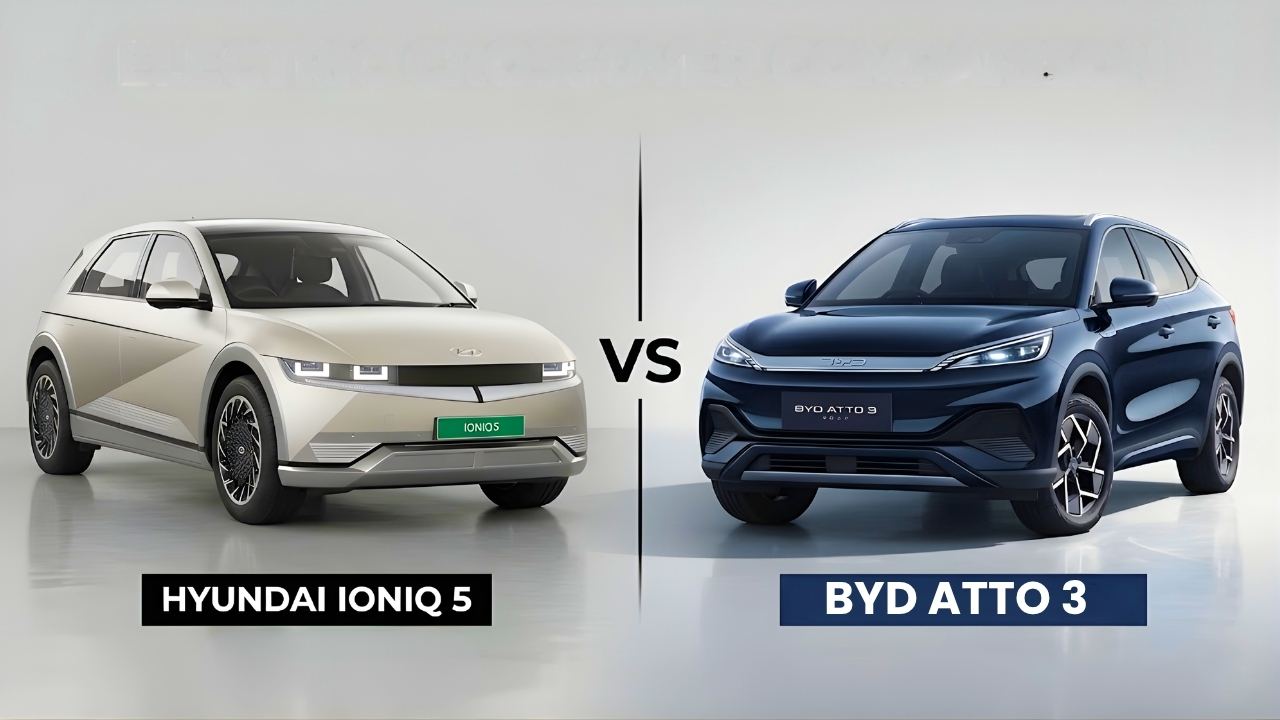
BYD Atto 3 and Hyundai Ioniq 5 are all-electric SUVs; however, the Atto 3 is a compact SUV, while the Ioniq 5 is a crossover. In the Indian market, the BYD model is available in three variants, whereas the Hyundai model is available in just one.
The three models of the Atto 3, which are Dynamic, Premium, and Superior, and they have ex-showroom prices of ₹24.99 lakh, ₹29.85 lakh, and ₹33.99 lakh, respectively; meanwhile, the single available model of the Ioniq 5 carries an ex-showroom price of ₹46.30 lakh.
Powertrain & Performance
The Atto 3 and Ioniq 5 come equipped with a Permanent Magnet Synchronous (PMS) motor. In the BYD model, the motor is mounted on the front wheels, meaning it features a FWD configuration, whereas in the Hyundai, the motor is located on the rear wheels, offering a RWD drivetrain.
However, both electric vehicles utilise a single-speed automatic transmission, ensuring a smooth driving experience. With the Atto 3’s 49.92 kWh and 60.48 kWh battery pack and the Ioniq 5’s 72.6 kWh pack, the ARAI-certified range on a full charge stands at 486-521 km for the BYD and 631 km for the Hyundai.
However, in real-world driving conditions it ranges from 350 to 400 km and 400 to 450 km for the Atto 3’s Dynamic and Premium & Superior, respectively, and 500 to 550 km for the Ioniq 5; both electric vehicles deliver superior performance under favourable driving circumstances.
The Atto 3 features a power output of 201 hp, 310 Nm of torque, a 0–100 km/h acceleration time of 7.9 seconds, and a top speed of 160 km/h, making it ideal for daily use. The Ioniq 5, on the other hand, delivers 214 hp, 350 Nm of torque, a 0–100 km/h acceleration time of 7.6 seconds, and a top speed of 185 km/h, giving it a strong pull.
Both the Atto 3 and Ioniq 5 come equipped with AC and DC charging options, and both feature an electrical architecture based on an 800-volt system. The Atto 3 comes with a 6.3 kW charger, while the Ioniq 5 features an 11 kW charger; fully charging takes 10–11 hours and 7–8 hours, respectively.
The BYD model supports DC charging capacity up to 80 kW, allowing it to charge from 0 to 80% in 50 minutes, while the Hyundai model supports a DC charging capacity of a maximum of 350 kW, enabling it to charge from 10 to 80% in just 18 minutes.
Interior & Features
The interior of the BYD Atto 3 features a gym-inspired design, incorporating a 12.8-inch rotating touchscreen for infotainment, a 5-inch digital instrument cluster, a panoramic sunroof, wireless phone charging, ambient lighting, connected car tech with voice control and other smart features.
Whereas the design of the Hyundai Ioniq 5 is quite clean, minimalist, and lounge-like, featuring a dual-screen setup with two 12.3-inch displays serving as the infotainment system and driver display, along with ventilated and heated seats, dual-zone climate control, and power-adjustable seats with memory.
Both the Atto 3 and the Ioniq 5 come with a seating capacity of five; however, in the BYD model, only four adults can sit comfortably, whereas the Hyundai offers superior spaciousness for five people.
Regarding cargo space, the Atto 3 provides 440 litres, which can be expanded to 1,340 litres by folding down the rear seats, while the Ioniq offers 527 litres, capable of easily accommodating 4 to 5 pieces of luggage. The Hyundai also features a frunk space, which helps in carrying small bags.
Exterior & Design
The BYD Atto 3 is quite modern and sporty; its aesthetic is clean and conventional, featuring soft curves. The front fascia sports LED headlamps paired with a simple grille, and the vehicle comes equipped with 18-inch alloy wheels, and connected LED tail lamps are added to the rear.
In contrast, the Hyundai Ioniq 5 features a retro-futuristic design characterised by “Parametric Pixel” LED lights and sharp geometric lines that lend it a boxy silhouette; it also features a clamshell bonnet, flush-fitting door handles, and 20-inch alloy wheels.
In terms of dimensions, the Ioniq 5 is larger; its length, width, height, and wheelbase measure 4635 mm, 1890 mm, 1625 mm, and 3000 mm, respectively. In contrast, the Atto 3 has a length of 4455 mm, a width of 1875 mm, a height of 1615 mm, and a wheelbase of 2720 mm.
The BYD model offers greater ground clearance at 175 mm, whereas the Ioniq 5 has only 163 mm. Even though there is a 12 mm difference in their ground clearance, both still easily clear speed breakers and potholes.
You can also check out other EV Battles: Tata Nexon EV vs MG ZS EV.
