
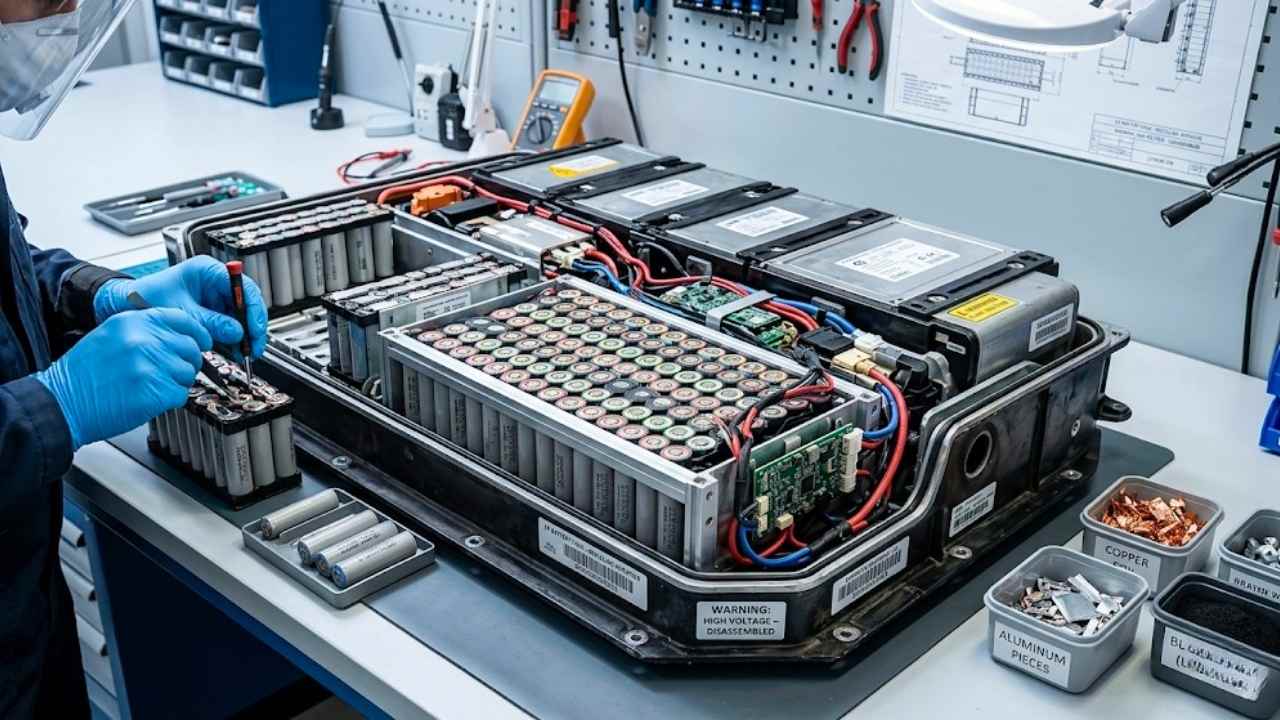
We are all well aware that people are increasingly choosing electric vehicles over traditional internal combustion engine (ICE) vehicles; indeed, this trend is being observed globally. Just last year, worldwide sales figures for these vehicles reached into the millions.
It is a positive development, as it aids us in safeguarding our environment; specifically, a prevalence of zero-emission vehicles on the roads will help mitigate the threat of global warming. However, electric vehicles present a distinct challenge regarding their batteries.
As we know, EVs utilise lithium-ion batteries, which have an average lifespan of approximately 10 years; once they reach the end of their service life, recycling them proves to be quite difficult. Currently, more than 500,000 batteries are retired annually, and this figure is projected to exceed 7 million by 2035.
The batteries used in electric vehicles contain four primary materials, which are Lithium (Li), Cobalt (Co), Nickel (Ni), and Manganese (Mn). If these materials are not recycled, it could lead to future difficulties regarding the availability of raw materials, potentially resulting in severe disruptions to the supply chain.
What are technologies for EV battery recovery?
Currently, there are three main technologies available that facilitate the recycling of EV batteries. This process allows for the extraction of valuable materials to ensure that they are reused. The objective is to prevent future shortages of these materials and to avert any disruptions within the supply chain.
Pyrometallurgical Recovery (Smelting)
Under this method, the battery is melted in a high-temperature furnace, a process that causes the metals to melt and form an alloy. The advantage of this approach is that it can be applied to all types of batteries; however, it is highly energy-intensive, and the recovery of lithium and aluminium is not achieved efficiently.
Hydrometallurgical Recovery (Chemical Leaching)
It is a widely used modern technique in which the battery is dismantled, and subsequently, through a shredding process, “black mass” is extracted; this black mass contains all the important metals. The advantage of this method is that it offers a high recovery rate for Li, Co, and Ni and is also energy-efficient.
Direct Recycling (Cathode-to-Cathode Recovery)
It represents next-generation technology in which cathode materials are repaired and recovered without being broken down, thereby enabling their direct reuse in new batteries. In addition to being highly energy-efficient, this process delivers maximum value; however, it requires that the battery chemistry be uniform.
What problems are being encountered in recycling electric vehicle batteries?
There is not just one, but numerous problems associated with the recovery of electric vehicle batteries, which we have discussed below.
- The first challenge is a lack of standardisation; all companies are utilising batteries of varying types, sizes, and chemical compositions in their EV models. These batteries must be dismantled manually, which is quite costly. Since the batteries differ completely from one another, automating their dismantling is also extremely difficult.
- The other issue concerns economic viability. Often, the cost of dismantling batteries to recover the metals exceeds the actual value of the materials themselves; this is particularly true for LPF batteries. Consequently, companies frequently incur financial losses, which is precisely why these batteries often do not get recycled.
- There is also a safety risk involved, as old batteries tend to be damaged or unstable, and there remains a persistent danger of cell displacement within them. For this very reason, their transportation and storage are also hazardous, as there is a risk of unforeseen incidents occurring.
- There are also issues regarding collection and logistics; used batteries remain scattered across various locations because a proper collection system has not yet been developed. Research indicates that for sustainable recycling, the collection rate must be at least 84 percent.
- The material separation process is highly compact. We all know that batteries contain Li, Co, Ni, and Mn, and separating these elements from “black mass” is not only extremely difficult but also quite expensive.
- The technology for recycling electric vehicle batteries is currently very limited, as each battery chemistry requires a distinct process.
