
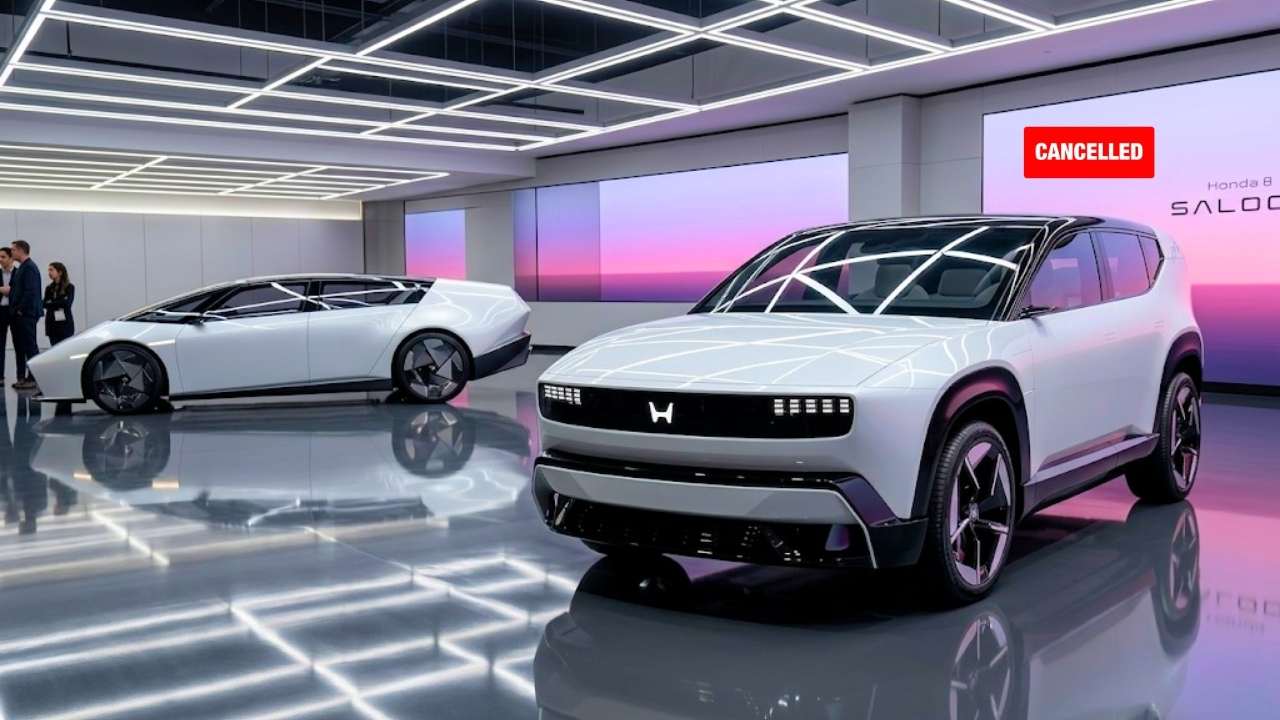
Honda has cancelled both of its upcoming electric vehicles, the Honda 0 Series SUV and the Honda 0 Series Sedan (Saloon), prior to the commencement of production. The list of cancellations is not limited to just these two models; Acura, a division of Honda, has also cancelled the Acura RSX EV.
Until just a few months ago, Honda was marketing its 0 Series EVs with great vigour; the company had even invested $4.4 billion in development to boost its electric vehicle product lineup in North America. Consequently, the subsequent cancellation of the project has come as a shock to many.
Production for these three electric vehicles by the Japanese automaker was scheduled to commence within the next few months; all three EVs were based on Honda’s proprietary ‘Zero’ platform. The cancellation of these models is a big development, and we have discussed this matter in detail below.
Why did Honda cancel all its upcoming EVs?
The cancellation of Honda’s 0 Series SUV, 0 Series Saloon (sedan), and Acura RSX EV has come as a last-minute shock to EV enthusiasts worldwide, as these EVs were slated for launch very soon. There is no single reason behind the scrapping of the launch plans for these EVs; rather, there are multiple reasons, some important ones discussed below.
Serious Financial Trouble
- A major reason behind the cancellation of the launch of these three upcoming Honda EVs is that the company is currently navigating an extremely challenging situation.
- It has already incurred huge losses due to its EV launches; had it not cancelled the launch of these three models, it would have faced substantial long-term financial losses.
EV Demand Decreases
- The demand for electric vehicles appears to have been declining over the past few months, not only in the US but across the entire world. In the United States alone, a sharp decline has been observed in EV purchases compared to the previous year.
- The expectation was that people’s interest in electric vehicles would grow over time; however, this does not appear to be happening. One of the reasons behind this is that people have concerns regarding charging infrastructure and range.
Strong Competition
- EV manufacturers worldwide are facing stiff competition from Chinese EV makers. It is because they are more technologically advanced in terms of software, possess faster production capabilities, and maintain lower costs.
- Honda has also acknowledged that its electric vehicles have become somewhat less competitive.
What is Honda’s future plan for electric vehicles?
Honda has cancelled its upcoming electric vehicle project; however, this does not imply that the company will never undertake EV production in the future. They have merely shelved the project as a strategic move designed to prevent the company from incurring further financial losses.
The company also has a short-term plan to focus on hybrid technology; it is expected that we will begin to see hybrid models starting in early 2017. The objective behind this strategy is to enhance the company’s profitability while simultaneously maintaining its competitiveness.
Honda intends to make a gradual comeback in the EV sector; the company plans to develop a new dedicated EV platform to be known as the “Honda e:architecture”. In the future, the new EVs launched by Honda will primarily target key markets such as China and India.
Since Honda has invested millions of dollars in electric vehicle production, it will undoubtedly be working on some advanced technology so that, when it re-enters the market, it can offer stronger competition to its rivals.
Honda has not made any changes to its long-term plans regarding electric vehicles; its resolve to establish a strong presence by 2030 remains unchanged. The company’s objective is to produce millions of 100% zero-emission electric vehicles annually by 2040.
What are other automakers doing with their EV plans?
It is not just Honda; other automakers manufacturing electric vehicles are also making adjustments to their EV plans. Some have slowed down production, while others have cancelled numerous upcoming EV models. The primary reason behind this is a decline in the market demand for electric vehicles.
Ford has incurred a loss of $19.5 billion, and GM has suffered a loss of $6 billion due to their electric vehicle production efforts. These developments are occurring primarily because of a lack of adequate charging infrastructure and the inability of EVs to deliver the driving range required to meet consumer expectations.
