
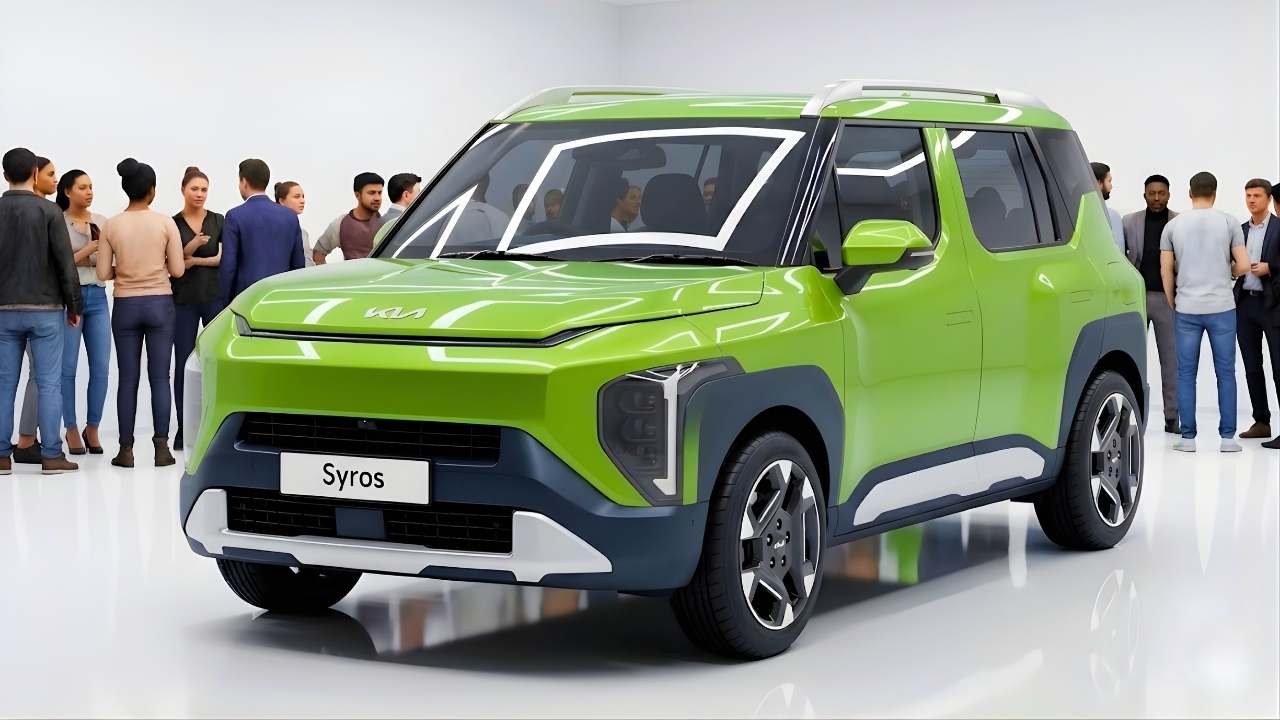
Kia Motors will soon introduce Syros EV in the Indian market. In the last few months it has been spied testing on the road multiple times. Recent reports suggest that its launch may take place in the third quarter of 2026.
Its ex-showroom prices are projected to be between ₹14 lakh and ₹20 lakh, depending on the variants. Its design and interior are quite similar to its ICE variant, but with a few changes to ensure better efficiency.
The Syros EV is all set to be positioned in the brand’s EV portfolio below its sibling Carens EV. Its launch will give tough competition to the Tata Punch EV, Mahindra XUV 3XO EV, Maruti eVitara and Hyundai Creta Electric.
Exterior
Up front, it is set to get a faux grille instead of the traditional one, which improves aerodynamics and gives a clear EV look. Vertical LED headlamps and DRLs give it a modern appearance, the ‘Digital Tiger Face’ reflects the brand identity, and a sculpted bonnet enhances its road presence.
On the side, it has a boxy silhouette that gives it a rugged SUV look. It features a tall stance and squared wheel arches, which enhances road practicality. It is most likely to run on the aero-optimised wheels that further improve its efficiency. Flush-type door handles add premiums to its side profile.
At the back, it is likely to get L-shaped vertical lights featuring modern styling and flat and upright tailgates to reinforce the SUV look. The spoilers are interested in a back body that improves aerodynamics and also adds a sporty touch, and a wide rear bumper improves its road presence and stability.
Interior
It features a spacious cabin with an upright design that ensures ample legroom and headroom. The front seats are ventilated, and the rear seat gets separate AC vents. Seats are made up of soft-touch premium-quality material, which ensures occupants don’t feel uncomfortable during long distances.
It gets two large touch screens, one for infotainment that supports wireless connectivity such as Apple CarPlay and Android Auto and another one as an instrument cluster that shows driving data. Also includes wireless charging, connected car technology, voice commands and OTA updates, and multiple USB charging ports.
It is likely to get up to eight airbags in the steering wheel, dashboard, front seats, roof rails and under the dash, which plays a crucial role in saving lives. Other safety features are advanced driver assistance systems, ABS with EBD, ESC, 360° camera and parking sensors, and ISOFIX child seat mounts.
Dimensions
The Syros EV measures the same as its ICE variant. Its length is 3995 mm, width is 1805 mm and height is 1680 mm. The wheelbase of 2550 mm is quite long and provides better stability. The ground clearance is 190 mm, good for Indian road conditions, and it can easily pass the potholes and speed breakers.
It features 5 doors: four on the side and 1 in the rear as a tailgate. It has a seating capacity of 5 people with a layout of 2-3. The kerb weight is 465 kg, and boot space is 465 litres, which is capable of carrying big luggage. The rear seats are foldable and can increase the cargo significantly depending on the needs.
Specification
The Syros EV is based on the Inster EV from Hyundai Motors, so it is expected to get two battery packs that are 42 kWh and 49 kWh, which may run up to 410 km and 450 km on one full charge. It is set to have a single motor that is mounted with the front axle, which means it will feature the drivetrain of AWD.
The standard battery trim may generate the power of 133 bhp, and the higher one may generate 169 bhp. The top speed is anticipated to be between 160 and 170 km/h, and acceleration timing for 0-100 km/h may be 7.5-9.5 seconds, depending on the variant.
It is based on 800-volt electrical architecture, and supports both AC and DC chargers with maximum capacities of up to 11 kWh and 125 kWh, respectively. The AC charger may take 7-8 hours for a full charge, and a DC one may take around 40 minutes for a 10-80% charge.
