
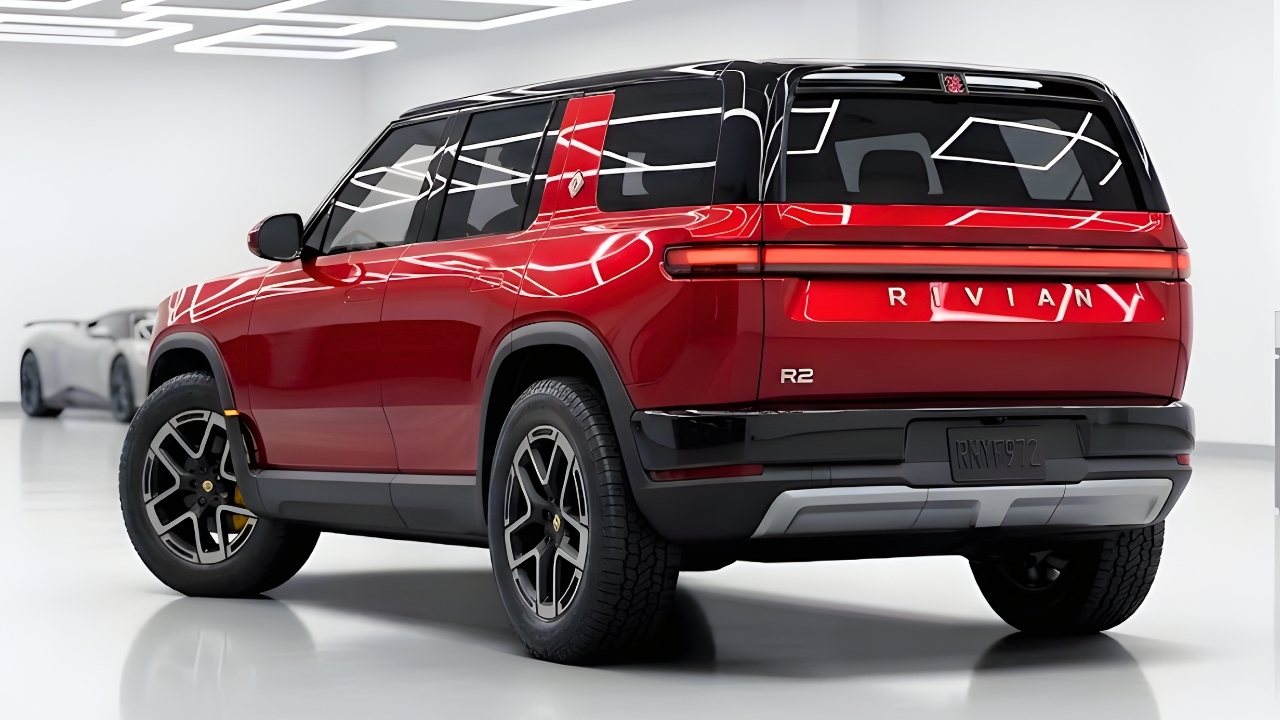
The Rivian R2 is set to be the company’s first electric vehicle to launch globally. It will be introduced in the global market in three variants: Standard, Performance, and Premium. Auto enthusiasts worldwide are eagerly awaiting the launch of this electric car.
Since this EV model will be exported globally from the United States, it is evident that its price will increase due to logistical costs. To address this issue, the company is implementing certain cost-cutting measures.
To maintain competitive pricing in the European and Asian markets, it is essential for the company to implement cost-cutting measures that do not compromise quality. In this article, we have discussed in detail the company’s cost-cutting strategy.
Rivian’s cost-cutting strategy for R2
One of the cost-cutting measures adopted by Rivian to maintain the competitive pricing of the R2 in the global market concerns how this electric car connects to the internet.
Like other modern electric vehicles, this one also features a 5G connection that facilitates over-the-air software updates and receives remote commands from a standard smartphone; however, what sets this electric car apart from the rest is that its internet connectivity hardware will be standardised across all units, regardless of the country in which they are sold.
As a result of this, there will be no need to stock a large number of different parts, which will ultimately lead to significant cost savings.
To make these capabilities possible, Rivian’s R2 is set to become the world’s first electric vehicle to utilise the GSMA SGP.32 standard for 5G connectivity. Fundamentally, this technology has been developed for Internet of Things (IoT) applications, enabling the company to seamlessly manage carrier profiles remotely without requiring any hardware modifications.
Which connectivity does Rivian use in its R2?
The Rivian R2 in the United States is set to feature AT&T connectivity, and the company will export its vehicles globally equipped with this very same hardware, even to regions where AT&T does not operate.
For countries where AT&T does not provide service, the company can remotely switch the operator within the hardware without requiring the vehicle to be brought into a service centre.
The architecture employed in this electric car enables the company to remotely activate, deactivate, or delete eSIM profiles without any manual intervention. Rivian R2 utilises automotive-grade eSIM hardware developed by Giesecke+Devrient, which also provides the necessary remote management infrastructure.
What about the Rivian R2 launch globally?
Rivian is set to launch the Standard, Premium, and Performance variants of the R2 in the United States in late 2026 and early 2026, respectively. Within just a few months of its US debut, it will be introduced to the European market, following which it will be launched in the Asian market.
The pricing and specifications for each variant, i.e., standard, premium, and performance, of the Rivian R2 have been shared below. You can learn more from below.
- Standard: In the US, the price is expected to range between $45,000 and $48,490. It will launch with a single-motor, rear-wheel-drive configuration that generates 350 hp of power and 355 lb-ft of torque. Its acceleration time from 0 to 60 mph is 5.9 seconds, and on a full charge, its range will be 275 to 345 miles.
- Premium: Its price is set to range between $53,990 and $55,448. It will feature a dual-motor, all-wheel-drive configuration capable of generating 450 hp of power and 537 lb-ft of torque. Its 0–60 mph acceleration time is just 4.6 seconds, and it offers a range of 330 miles on a full charge.
- Performance: It is priced between $57,990 and $59,485 in the US; it will also come with a dual-motor all-wheel-drive configuration that produces 656 HP and 609 lb-ft of torque. The 0 to 60 mph acceleration time is just 3.6 seconds, and it has a range of 323 miles.