
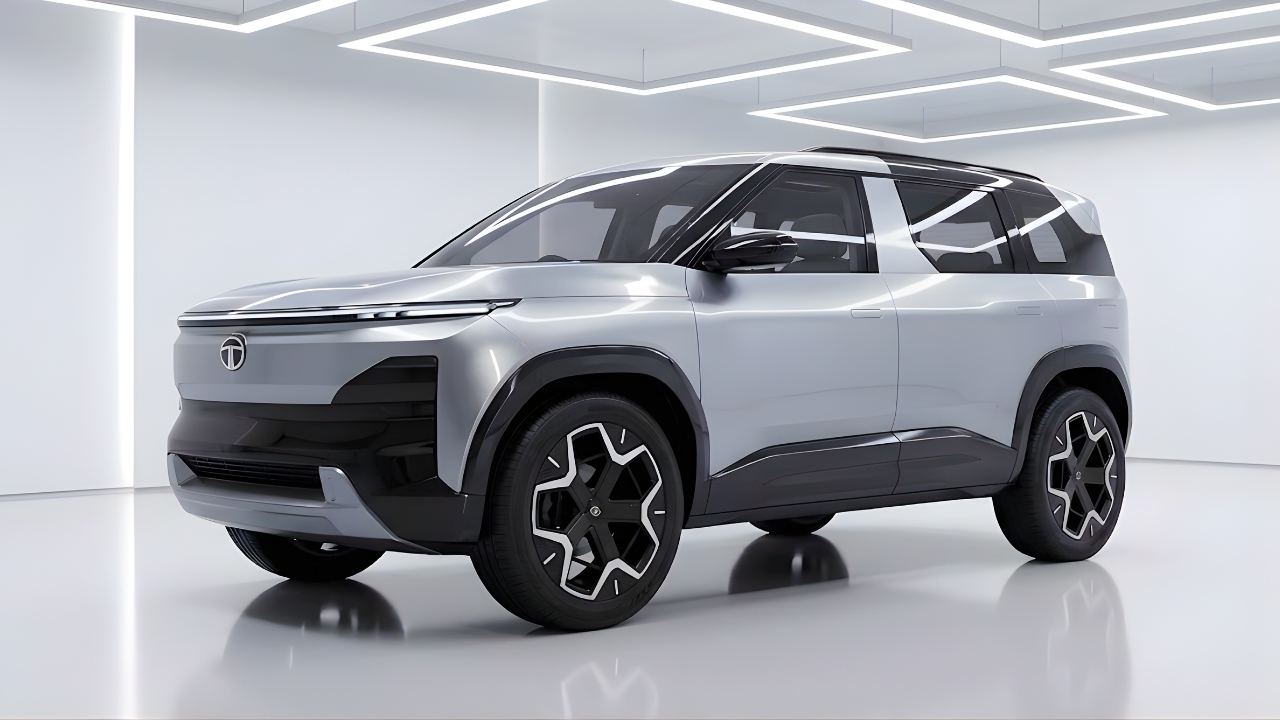
The launch of Tata Motors’ most-awaited electric vehicle, Sierra.ev, has been confirmed for May 2026. The company had previously indicated that the launch would take place during the first quarter of the 2027 financial year; now, with the confirmation EV enthusiasts across the country are increasingly keen to learn more about the vehicle.
Tata Motors has commenced preparations for the launch of the Sierra.ev, and we can expect to see it on public roads very soon. It is anticipated that pre-bookings will open simultaneously with the launch with expected starting ex-showroom price of ₹15 lakh, and deliveries are expected to commence by mid to late August 2026.
Within the company’s EV portfolio, this model is set to be positioned below the Harrier.ev, meaning it is poised to offer stiff competition to all mid-size electric SUVs in India, including the Mahindra BE6, Maruti eVitara, and Hyundai Creta Electric. While details for the EV have not yet been revealed, we have shared everything we currently know about it below.
Exterior & Design
The design of the Sierra.ev is set to be not only aerodynamic but also futuristic; notably, it will feature a closed front grille, a signature element of EV styling. Connected LED lights are expected to span the entire width of the vehicle. Its roofline is anticipated to be flat, thereby lending it a strong road presence. The door handles are expected to be of the flush-fitting type, while the wheels are likely to feature a dual-tone finish.
Furthermore, its boxy silhouette and upright stance will give it an aggressive visual appeal. At the rear, we can expect to see a full-width LED taillight bar and a wraparound rear glass panel, ensuring that the vehicle presents a catchy appearance even when viewed from behind. While its exact dimensions have not yet been disclosed, it is expected to have a length of 4300 mm, a wheelbase of 2600 mm, and ground clearance of 200 mm.
Interior & Features
The interior of the Sierra.ev is set to be quite spacious. Its cabin design will be distinctly aesthetic, featuring a three-screen setup: one for the driver, a second for infotainment, and a third for the passengers. The dashboard will be very clean and minimalistic, meaning there will be very few physical buttons, as all controls will be managed via touch interfaces.
The cabin will be equipped with a host of high-tech, smart, and advanced features with a panoramic sunroof, which maximises comfort and convenience for all occupants, giving the interior a distinctly futuristic aesthetic. It offers a seating capacity for five occupants, and all three adults seated in the back enjoy ample shoulder room and legroom. It will also feature a boot space of 450 litres, which can accommodate five large suitcases.
It comes equipped with a 12-speaker JBL audio system featuring Dolby Atmos, along with wireless connectivity features such as Apple CarPlay and Android Auto. For occupant safety, it features multiple airbags, as well as other safety systems such as Level 2 ADAS, ABS with EBD, an electronic stability program, and a traction control system.
Powertrain & Performance
Based on the Gen 2 Acti.ev architecture, the Sierra.ev will be available with both single-motor (front-wheel drive) and dual-motor (all-wheel drive) drivetrain options. The transmission will be a single-speed automatic, ensuring a smooth and noiseless driving experience in both city traffic and highway conditions.
It will come with a choice of two battery packs: a 55 kWh option and a 65 kWh option. It is worth noting that the variant featuring the AWD powertrain will be designated as QWD (Quad-Wheel Drive). It doesn’t signify a distinct type of drivetrain; rather, it is a naming convention adopted by the company for all its EVs equipped with an AWD system.
Details regarding range, power output, acceleration, timing, and top speed are not yet available in the public domain. However, it is expected that the range for the model equipped with a 55 kWh battery will be near 450 km, while the 65 kWh variant will offer a range of around 650 km. Both models will support fast charging, taking likely half an hour to charge from 30% to 80%.
