
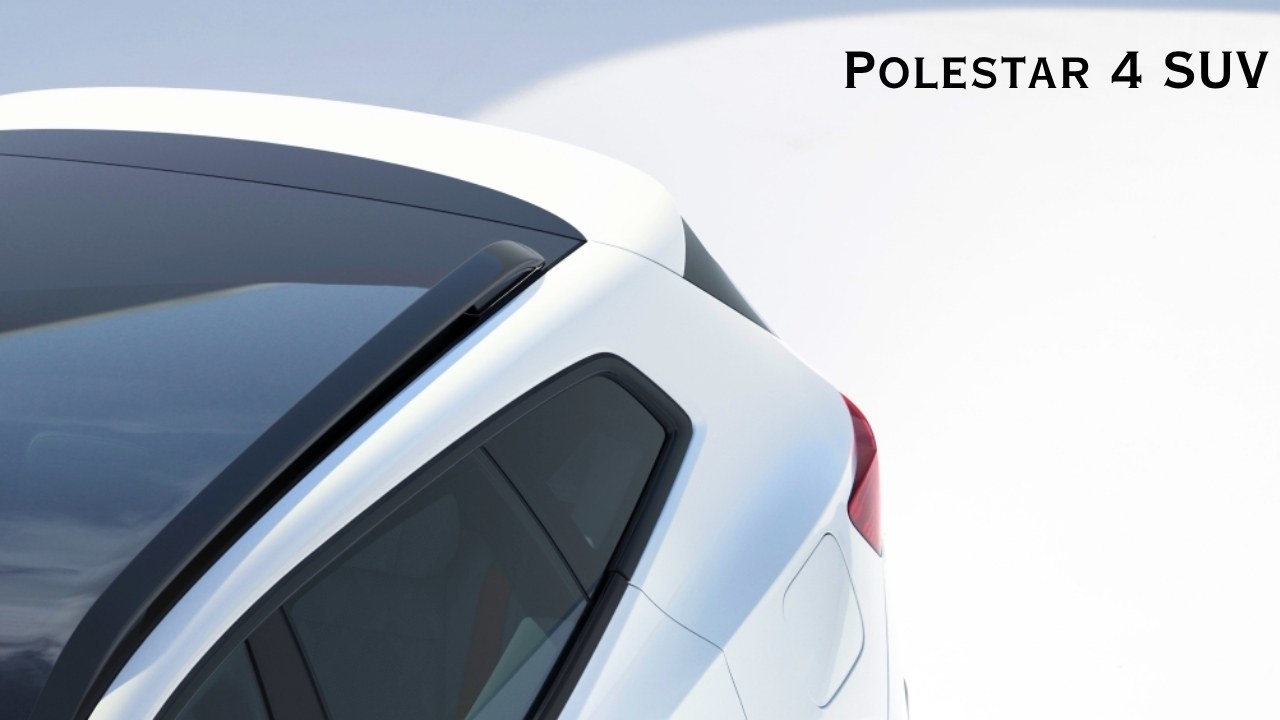
On July 7, 2026, Polestar, the Swedish premium electric vehicle (EV) manufacturer, announced that they are going to launch a new Polestar 4 SUV, which is set to be a more practical version of the existing coupe. They have officially confirmed that they will launch the model on September 2, 2026, and start the sale simultaneously.
The launch will happen in the majority of Polestar’s 31 global markets, including Europe, Australia, and other countries where Polestar operates. Notably, the country-by-country rollout schedule is still pending. They have confirmed that the production of this upcoming electric sport utility vehicle will take place in Busan, South Korea.
This electric SUV is set to be a revised version of the existing coupe. Reportedly, if you replace the roof-mounted camera at the back, it will get a rear windshield for a clearer view of the vehicle running behind. It will have a rear upright stance that will significantly improve the cargo capacity to carry big luggage conventionally.
In the press release, they also mentioned that besides revising the exterior, they will introduce retuned suspension and chassis to improve the driving comfort and stability. The upcoming electric SUV is anticipated to be slightly costlier than the coupe version, which cost between $57,800 and $74,300 in the United States.
There’s high speculation that Polestar will introduce this model to the US market starting from $59,000 and going up to $77,000. Following the launch, it will give tough competition to the Mercedes-Benz GLC EV, the Tesla Model Y, the BMW iX3, the Audi Q6 e-tron, and the Porsche Macan Electric.
In terms of length and width, the model is expected to remain the same as the coupe version, which measures 4,840 mm with a 2,999 mm wheelbase and is 2,139 mm wider, including mirrors. The height is anticipated to be increased slightly to 1534 mm; we are expecting it to be around 1610 mm, giving more ample headroom and large boot space.
The boot space in the existing version is 526 liters, but the upcoming version is anticipated to have a cargo capacity of above 800 liters, enabling the multi-big luggage carrying; the frunk (front trunk storage) is 33 liters. Set to make its debut with a seating capacity of 5 people in 2-3 arrangements.
The interior of the upcoming SUV is set to be the same as the coupe. The existing one gets a 15.4-inch touchscreen infotainment system at the center of the dashboard with Android Automotive OS, which supports Google Built-in with Google Maps, Gemini, and Play Store and OTA software updates. It is integrated with a 16-speaker premium Harman Kardon audio system, supporting wireless connectivity via Android Auto and Apple CarPlay.
Other notable features inside the coupe’s cabin are a three-spoke steering wheel; behind it, there’s a 10.2-inch digital instrument cluster showing all the driving data; a 14.7-inch head-up display showing all the data on the windshield; ventilated, heated, and electronically adjustable front seats with a memory function; dual-zone automatic climate control; and a 360° camera for the surround view.
The carmaker has officially confirmed that the upcoming electric SUV is set to be based on 400-volt electrical architecture in two drivetrain options that are rear-wheel-drive and quad-wheel-drive. The RWD is set to get a 272 hp permanent magnet synchronous motor on the rear axle with a single-speed automatic transmission; the AWD will get an additional induction motor on the front axle, whose combined power output is 544 hp.
They both are equipped with 100 kWh lithium-ion NMC battery packs, giving a WLTP range of 560 km for the standard and 630 km for the larger. The maximum speed for both variants is set to be 200 km/h. Acceleration timing for 0 to 100 km/h is yet to be revealed, but there’s high speculation that it will take a time of under 8 seconds and 4 seconds for the RWD and AWD variants, respectively.