
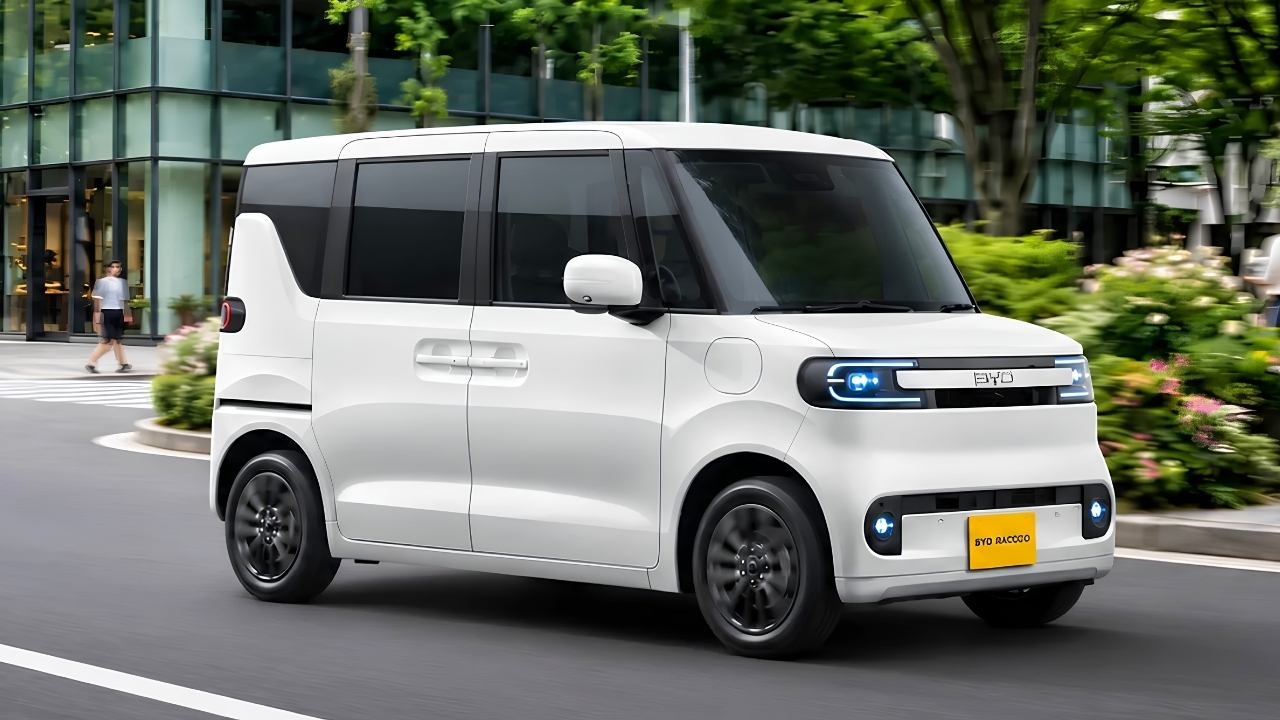
Buils Your Dreams will launch BYD Racco, a kei-class electric vehicle, which is set to make its debut in the Japanese market on July 28, 2026, after unveiling at the 2025 Japan Mobility Show. Set to be positioned as a rival to Nissan Sakura, Mitsubishi eK X EV, and Honda N-One e. The model will be available for sale with the expected price between ¥2 million and ¥5 million (₹11.7 lakh to ₹14.7 lakh).
Built on BYD’s e-Platform 3.0 featuring a permanent magnet synchronous motor on the front axle, the electric motor is mated with a single-speed automatic transmission. Since the e-motor is on the front axle, it features front-wheel drive. The PMSM’s maximum power output is 47 kW, and peak torque is 160 Nm. Under the floor, it gets a lithium-ion battery pack whose capacity varies from one to another depending on the variant.
The standard variant equipped with a 22.4 kWh BYD Blade battery pack gives a WLTC range of 210 km, and the same for the large one, 35.84 kWh, is 320 km. Features 400-volt electrical architecture, and the top two variants support DC chargers up to 50 kW, which takes only 35 minutes to charge the vehicle from 10 to 80 percent; the standard one supports only 37 kW fast DC charging and AC chargers up to 6 kW; however, the charging time for the same is still undisclosed.
One source claims that for the large battery pack, the AC charger of 6 kW will take 6 hours to add the 270 km. The acceleration timing for 0 to 60 km/h is all set to be different from one another depending on the battery pack and even top speed and variant. Reportedly, both variants are capable of vehicle-to-load; the top variant may have 1,500 watts to run external devices.
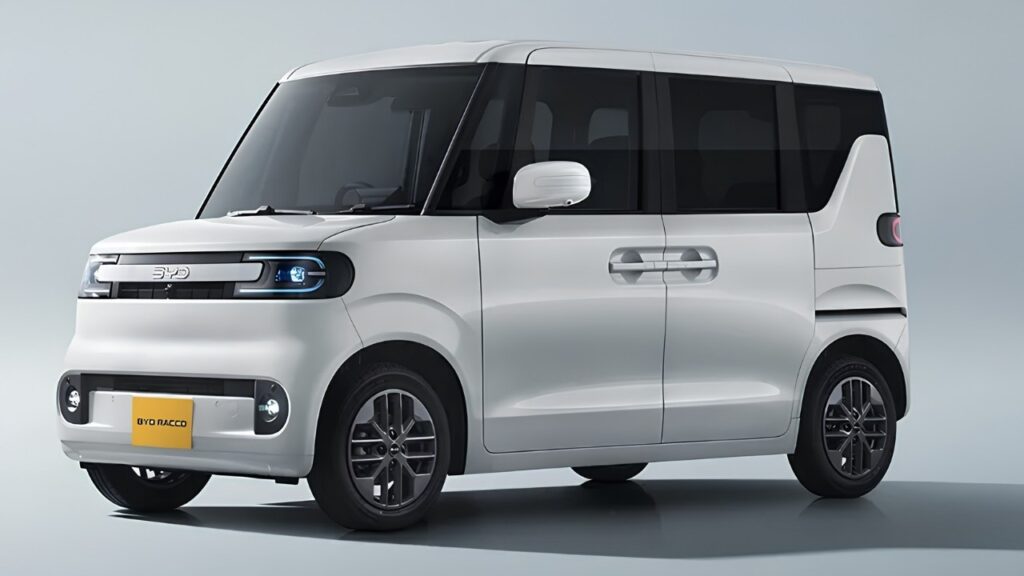
The length, width, and height are 3,395 mm, 1,475 mm, and 1,800 mm, respectively, and its wheelbase is 2,520 mm. For clarity, the BYD Racco is longer by 25 mm in terms of wheelbase compared to rivals from Nissan and Mitsubishi. The front and rear suspension are MacPherson strut and torsion beam, to ensure comfortable driving experience.
The front and rear brake are ventilated disc and disc, respectively. It also features regenerative braking, which changes braking force to electricity to charge back the battery pack. Also comes with the electronic parking brake, electronic stability control, and anti-locking braking system with electronic braking system to ensure safe braking.
Features four people seating capacity in a 2-2 layout with a boot space of 280 liters that can be expanded up to 1,372 liters when the rear seats are folded; on the center of the dashboard, it gets a 10.1-inch fixed touchscreen infotainment system that supports wireless connectivity via Android Auto and Apple CarPlay for video and audio streaming. It also supports Bluetooth connectivity, NFC smartphone key, and digital key.
The cabin also features USB charging ports (Type-A and Type-C) for phone charging convenience; under its steering wheel, it has a fully digital instrument cluster showing all driving data. It features heated front seats to enhance seating comfort for cold weather, and a 6-way power-adjustable driver’s seat helps in finding the comfortable driving position. The kerb weight is 1160 kg, 1220 kg, and 1230 kg for the 200, 300 Plus, and 300 Premium variants, respectively.
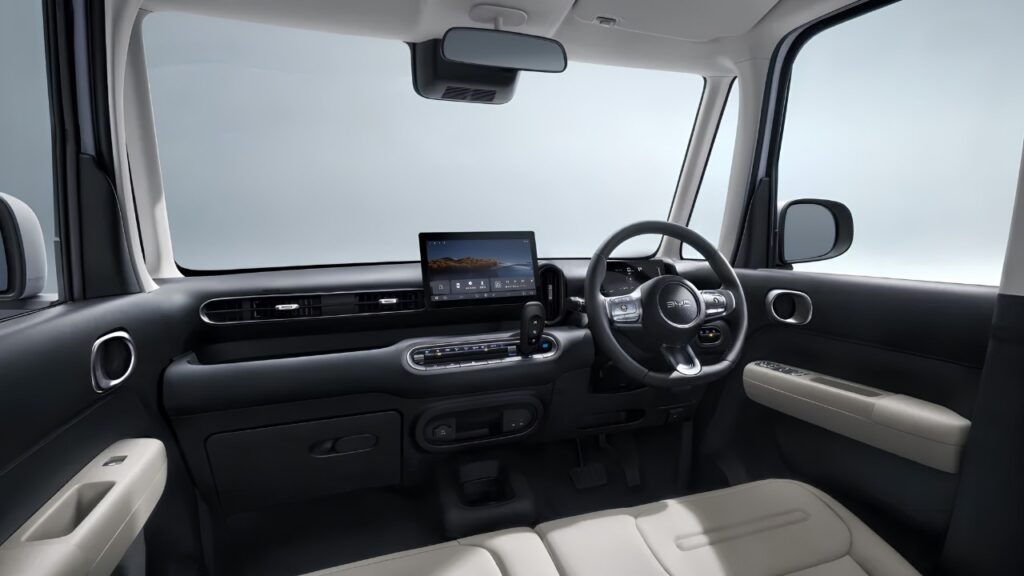
Even though its steering wheel is heated to enhance the comfort for the driver. Other notable features include a hot cup holder to keep the drink heated during winter, Level 2 ADAS to ease the driving experience, six airbags to ensure the safety of occupants during the accident, electric sliding rear doors for easier ingress and egress, and a tire pressure monitoring system that alerts when the tire pressure goes down.