
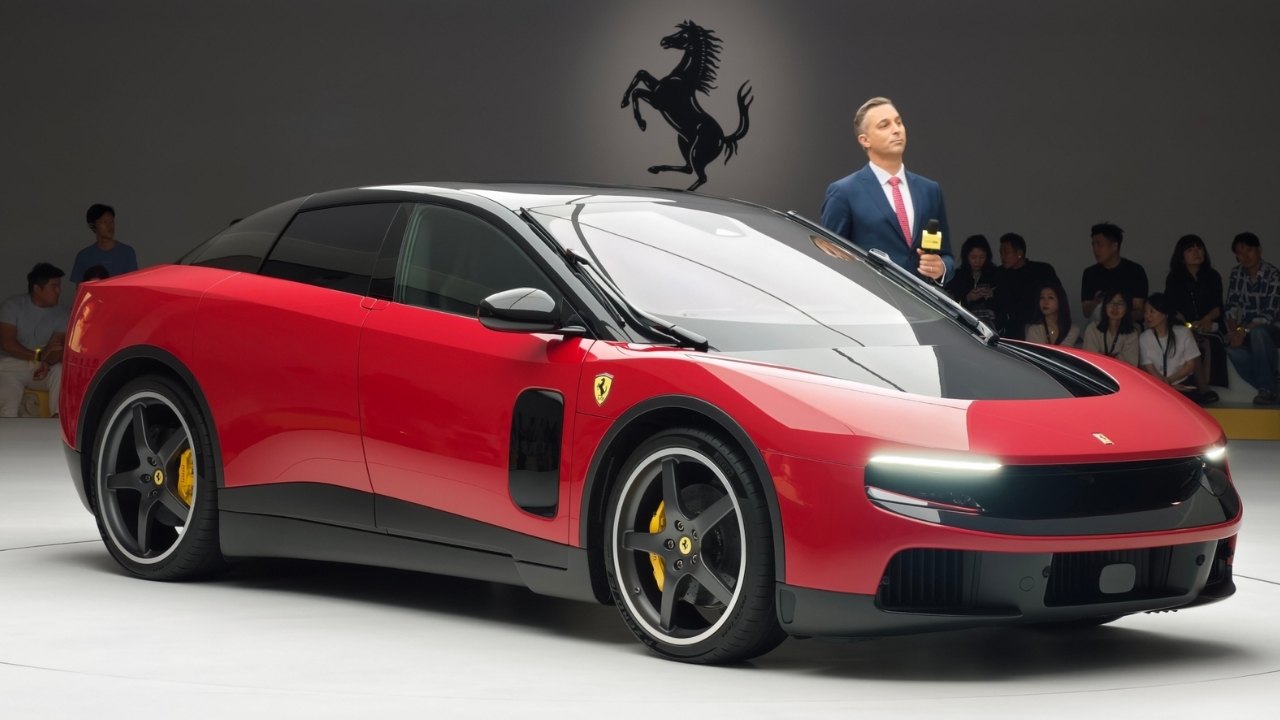
Ferrari, the Italian luxury automobile manufacturer, has launched its first pure-electric vehicle, Ferrari Luce, for the Chinese market with the price of 3,988,000 yuan, which translates to 5.54 crore rupees. They introduced only 88 units; reportedly, all were sold immediately.
In the Chinese market, there are no direct rivals to the Ferrari Luce, but the models that are quite close to it in terms of technicalities are the Yangwang U9 and the Hyptec SSR, with the price starting from 1,800,000 yuan (2.49 crore rupees) and 1,286,000 yuan (1.78 crore rupees).
Its four radial-flux permanent magnet synchronous motors, one on each axle, feature an all-wheel drive drivetrain to power all wheels. Each motor mounted on the front axle generates the power of 105 kW, and each on the rear axle produces 310 kW. The combined power output is 772 kW (1,036 hp), and peak torque is 990 Nm.
Equipped with a 122 kWh NMC (Nickel Manganese Cobalt) battery pack with the 800-volt electrical architecture. Its WLTP range is 530 kilometers; it can accelerate from 0 to 100 km/h in 2.50 seconds, and it is capable of accelerating up to 200 km/h in 6.8 seconds. The maximum speed this electric vehicle reaches is 310 km/h.
Supports DC charging up to 350 kW; with the maximum charging output, it will take 20 minutes of time for 10 to 80 percent charging, adding the WLTP range of 300 kilometers. Get a 22 kW on-board AC charger, which takes a time of only 6 hours 15 minutes to fully charge this electric vehicle.
Compared to the Yangwang U9 and the Hyptec SSR, the Ferrari Luce takes 0.14 seconds and 0.20 seconds longer to sprint from 0 to 100 km/h. Even in terms of power output, the Ferrari EV delivers 188 kW less power than the Yangwang electric car and 128 kW less than the Hyptec all-electric machine.
The length, width, and height of the Ferrari Luce are 5,026 mm, 1,999 mm, and 1,544 mm, respectively. The wheelbase is 2,961 mm, and the kerb weight is 2,260 kg. Features a seating capacity of 5 people in a 2-3 layout with a boot space of 597 liters behind the second row.
It features independent torque vectoring on all four wheels; rear-wheel steering to reduce the turning radius; 48V active suspension with adaptive damping to ensure smooth driving on all types of terrain; brake-by-wire with regenerative braking; and four driving modes, including Range, Tour, Performance, and Launch Control.
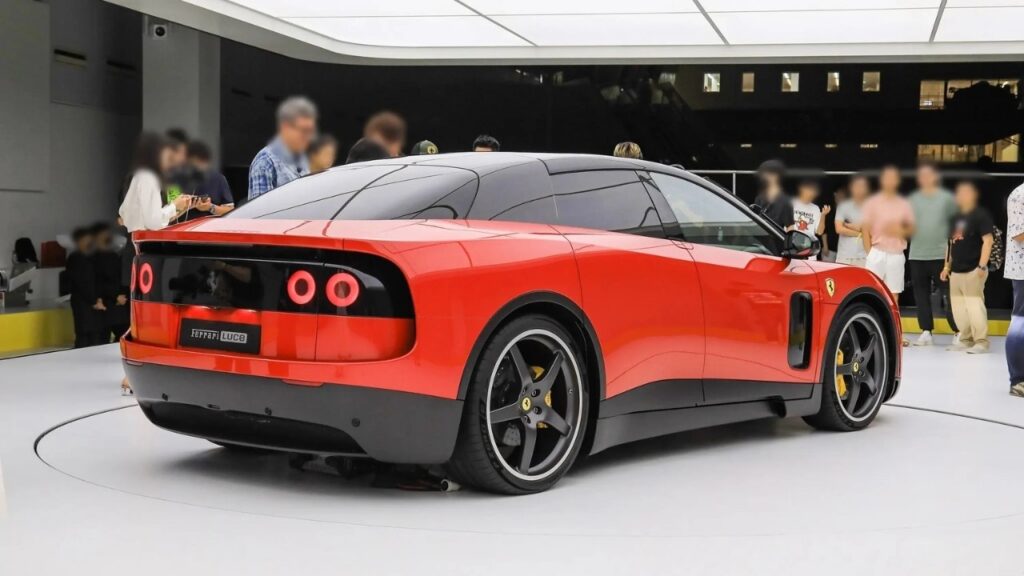
Outside, it gets sleek matrix LED headlights with daylight running lights, a full-width black glass panel, active air intakes, a sculpted bonnet with air channels, powered flush-type door handles, up to 24-inch alloy wheels, muscular wheel arches, quad-style LED taillights, a high-mounted LED stop lamp, and a powered liftback tailgate.
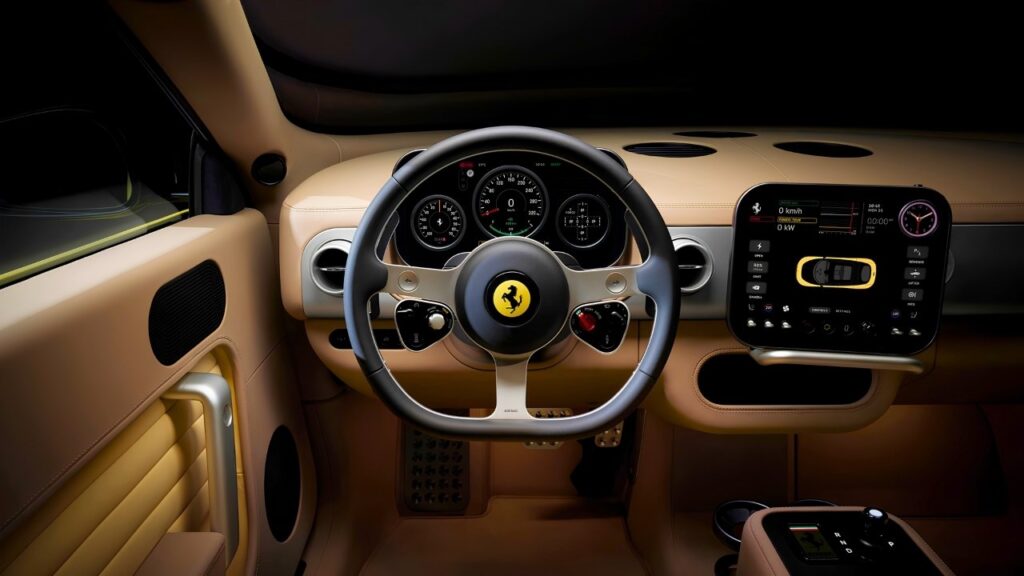
Inside, it gets a three-spoke steering wheel with a Ferrari logo, under which there’s a 12.86-inch digital instrument cluster with physical aluminum needles that show all the driving data, and a 10-inch rotating OLED central touchscreen is mounted in the center of the dashboard, supporting over-the-air (OTA) software updates and wireless connectivity via Android Auto and Apple CarPlay.
The infotainment system is integrated with a 21-speaker Ferrari premium surround sound system to enhance the audio experience inside the cabin. Other notable features are the USB-C charging port, wireless phone charging pad, heated, ventilated, and massage functions for the front seat, rear seat only heated, and panoramic glass roof.
For safety and convenience purposes, it gets an advanced driving assistant system suite to make driving stress-free, a 360° camera for surround view, a digital inside rearview mirror, parking sensors at both ends, keyless entry and push-button start, and a powered tailgate for hands-free access.
