BYD will soon launch the long-range version of the Ti7, a plug-in hybrid electric vehicle, in the domestic market in the very near future. China’s latest MIIT filing catalogue release has confirmed the technical details for this upcoming version. It is all set to get a 50 kWh lithium-ion BYD Blade 2.0 battery pack from FinDreams, giving an emission-free range of 230 km and 210 km for RWD and AWD variants, respectively, under the WLTC condition.
It is already on sale in the Chinese market under the Fang Cheng Bao with two different battery pack configurations: 26.6 kWh and 35.6 kWh, whose pure-electric WLTC range is 105 km and 140 km, respectively, for the RWD variant. The AWD variant is 130 km in the same condition. Equipped with a 1.5-liter four-cylinder turbocharged petrol-powered internal combustion engine, whose power output is 115 kW (154 hp).
The RWD has a permanent magnet synchronous motor on the rear axle, which generates the power of 200 kW (268 hp), and the AWD also features an induction motor on the front axle that delivers 160 kW (215 hp) of power. The combined power output is 360 kW (483 hp). The top speed is 190 km/h for both RWD and AWD. When the battery pack is depleted, the fuel efficiency is 5.75 to 5.98 liters per 100 km for RWDs and 6.3 liters per 100 km for AWD.
The weight of the 50 kWh battery pack is 384 kg; it is 164 kg heavier than the battery of BYD’s FCB Ti7. Reports have officially confirmed the kerb weight of the upcoming BYD Ti7; the RWD weighs 2,350 kg, and the AWD does 2,530 kg. Notably, the upcoming one with a larger battery will make its debut with the same 1.5L 4-cylinder petrol-turbo ICE that is used for the three existing variants under the Fang Cheng Bao banner.
The power output for the RWD and AWD is set to be the same as the existing version, including even top speed. But the fuel efficiency for the upcoming rear-wheel-drive and all-wheel-drive variants is claimed as 5.98 liters per 100 km and 6.3 liters per 100 km, respectively. The new one is set to support BYD’s ultra-fast DC charging, which takes 5 minutes for 10 to 70 percent charging and 9 minutes for up to 97 percent charging.
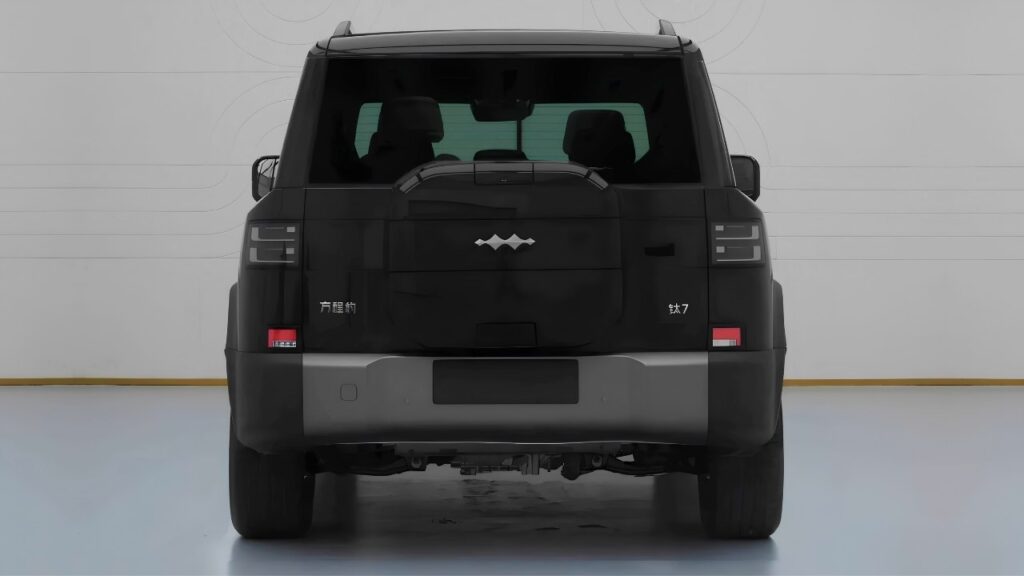
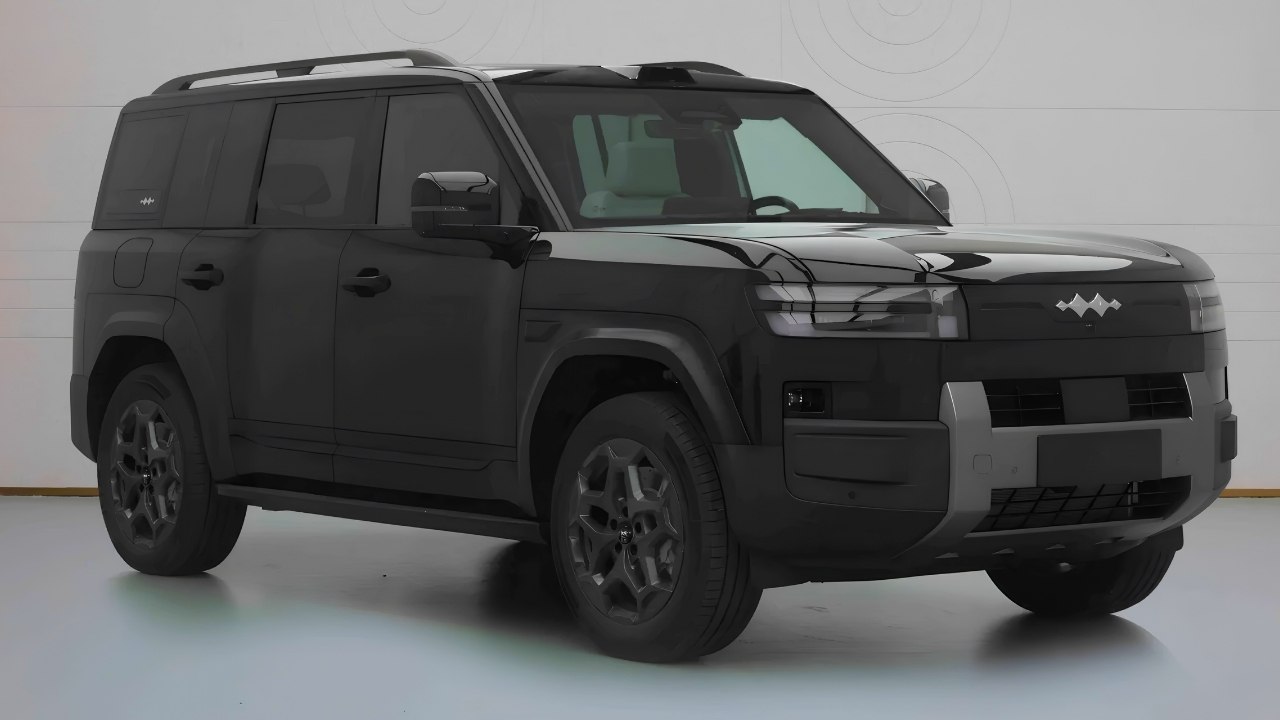
No dimensional changes are expected. The length, width, and height are set to be 4,999 mm, 1,995 mm, and 1,865 mm, respectively. It will make its debut with a seating capacity of 5 people in a 2-3 layout; thanks to a wheelbase of 2,920 mm, all occupants are set to get ample legroom to sit comfortably even for a long drive. Notably, the towing capacity is set to remain 2,000 kg.
Inside, it has a 15.6-inch rotating central touchscreen infotainment system at the center of the dashboard and a 12.3-inch full-digital instrument cluster under the steering wheel. The front seat is ventilated, heated, and powered with a memory function. Other notable features are the panoramic sunroof, multicolor ambient lighting, premium audio system, and Vehicle-to-Load (V2L) function.
Outside, it features sharp LED headlights, wheel arch cladding, a large outside rear-view mirror with integrated blinkers, mechanical door handles for better practicality, a roof-mounted rail to mount luggage and boxes on the roof, a rear spoiler to reduce turbulence at high speeds, a roof-mounted LIDAR sensor, a rugged bumper to give a tough look, a tailgate-mounted spare wheel, large alloy wheels, and a side-hinged tailgate.