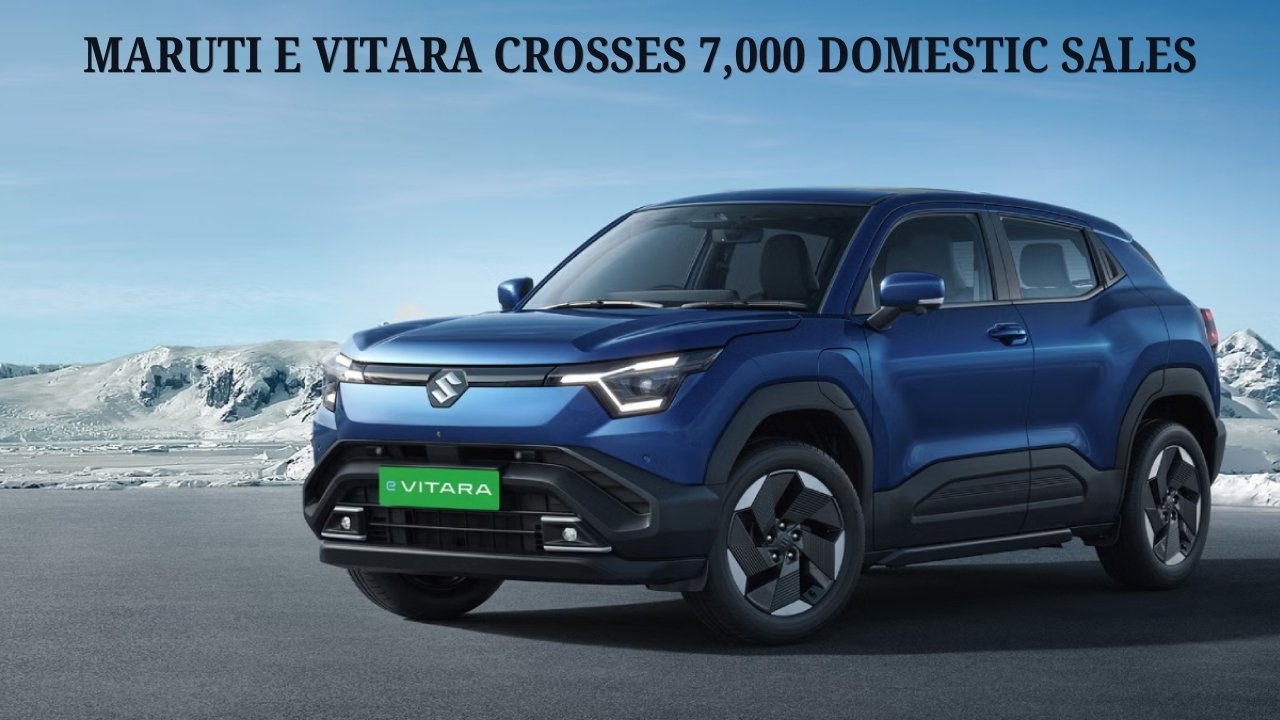
The e Vitara, a battery electric vehicle from Maruti Suzuki, has been available for sale in the Indian market since its launch. Reportedly, in 2026, between January and May, they have sold more than 7,000 units in India and exported more than 35,000 for the overseas market, including Europe, Japan, Latin America, Africa, the Middle East, and Asia-Pacific.
Maruti Suzuki sold 528 units in January 2026 and 870 in February 2026, with MoM growth of 64.8%; in March 2026, they sold 2,254 units, the highest in 2026, and registered a 159.1% MoM growth. After the first quarter of 2026, sales went down; only 2,006 units were sold out in April 2026, with a MoM decline of 11%; and a total of 1,439 units were sold out in May 2026, registering a MoM degrowth of 28.3%.
From January 1, 2026, to May 31, 2026, the carmaker has sold 7,097 units. Comparing the sales in India with the number of units exported, we find the ratio of 4.9:1, meaning for each unit sold in India, they exported 5 for the international market. The sale figures of the Maruti Suzuki e-Vitara in 2026 are not bad, as the electric vehicle market is still growing in India and buyers still have range anxiety.
It is available for sale in the Indian market in four variants that are Delta, Zeta, Alpha, and Alpha Dual Tone, with the ex-showroom prices of ₹15.99 lakh, ₹17.49 lakh, ₹19.79 lakh, and ₹20.01 lakh, respectively. The first variant is available with the 49 kWh lithium-ion battery pack, giving the ARAI-certified range of 440 km, but the last three have the 61 kWh, which runs up to 543 km.
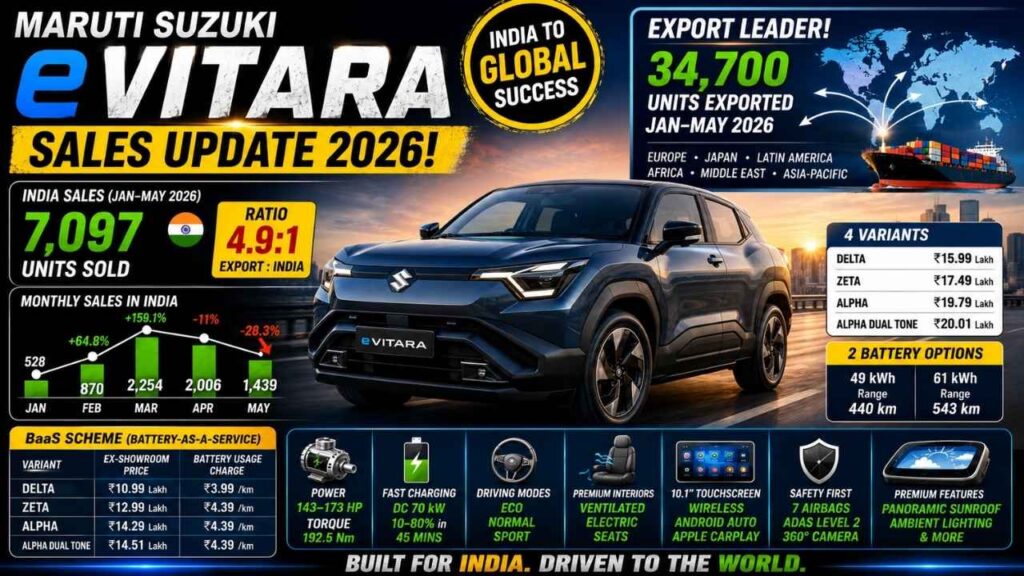
All variants of the Maruti Suzuki e Vitara are also available for sale under the Battery-as-a-Service (BaaS) scheme; the ex-showroom price for Delta is ₹10.99 lakh with a battery usage charge of ₹3.99 per km; for Zeta, it is ₹12.99 lakh with ₹4.39 per km; for Alpha, it is ₹14.29 lakh with ₹4.39 per km; and for Double Time Alpha, it is ₹14.51 lakh with ₹4.39 per km.
Get a permanent magnet synchronous motor on the front axle featuring a front-wheel drive drivetrain. The electric motor is mated with a single-speed automatic transmission, which generates power up to 143 hp (106 kW) with the Delta variant and a maximum of 173 hp (128 kW) for others, and the peak torque for all variants is 192.5 Nm.
The acceleration timing for 0 to 100 km/h is 9.6 seconds for the variant equipped with the standard battery pack and 8.6 with the larger one. Notably, the top speed for all is 150 km/h. Built on 400-volt electrical architecture supporting fast DC chargers up to 70 kW, which take 45 minutes for 10 to 80 percent charging for the larger battery pack.
Buyers get a 7.2 kW AC wall box, which takes around 6.5 hours and 9 hours for 10 to 80 percent charging for the variants with battery packs of 49 kWh and 61 kWh, respectively. Features three driving modes that are eco, normal, and sport and multi-level regenerative braking with paddle shifters.
It comes with a seating capacity of 5 people in a 2-3 layout with a boot space of 306 liters. Equipped with a 10.25-inch digital instrument cluster under a two-spoke steering wheel and a 10.1-inch touchscreen infotainment system at the center of the dashboard with connected car technology and wireless connectivity via Android Auto and Apple CarPlay.
Its front seats are ventilated and also electrically adjustable in 10 ways. Other feature highlights are a wireless phone charging pad, ambient lighting, a Level 2 ADAS suite, 7 airbags to ensure safety during a collision, a 360-degree camera, an electronic parking brake with auto hold, and a fixed panoramic glass roof.