Xiaomi Auto, the Chinese automobile manufacturer, has officially announced that they have delivered more than 30,000 units in June 2026, marking the third consecutive month in which they have crossed these sales figures. We will get to know the actual number of units delivered once the China Passenger Car Association has released the data.
Notably, in 2026, they have delivered more than 150,000 units. Reportedly, a total of 150,317 cars have been sold in the first five months, including 39,002 in January, 20,414 in February, 21,440 in March, 36,702 in May, and 32,759 in June 2026. January was the month in which they were about to touch the monthly sales figure of 40,000 but fell short by just 98 units.
In May, they dispatched 32,759 units, out of which 24,023 units are of the Xiaomi SU7 and 8,736 are of the Xiaomi YU7. The first one’s sales figure translates to 73.3% of total sales and the second one to 26.7%. It is highly expected that for June 2026, we will see the same sales pattern, meaning our total sales, now at 21,000 sales, would be for the SU7 and above 9,000 units for the YU7.
Analyzing the month-wise sales in 2026, we find that they registered a month-on-month degrowth of 47.66% in February; in March, they registered a MoM growth of 5.03%; even in April, sales grew by 71.18%, but again in May, the delivery declined by 71.18%. If June sale figures surpass those of May, then MoM growth may be registered; however, it is yet to be revealed if the sales for June are above 32,759 units.
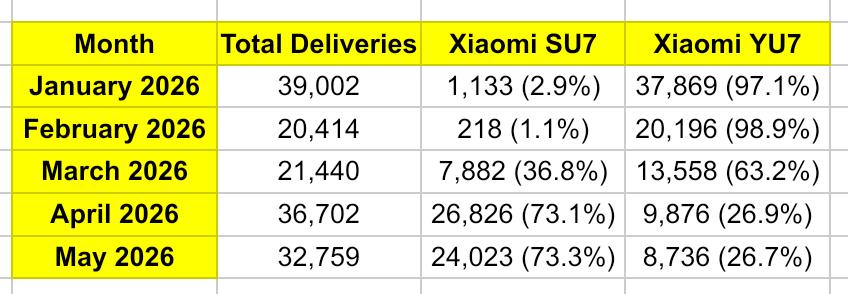
On sale from January 2026 to May 2026, a total of 60,082 units are of the SU7 and 90,235 of the YU7. A total of 60,082 SU7 unit sales includes 1,133 in January, 218 in February, 7,882 in March, 26,826 in April, and 24,023 in May. The carmaker has registered a month-on-month degrowth of 3,515.60% in February, a 240.34% boost in April, and 10.45% in May.
On the other hand, a total of 90,235 sales of YU7 include 37,869 in January, 20,196 in February, 13,558 in March, 9,876 in April, and 8,736 in May 2026. They have registered a month-on-month decline of 46.67% in February, 32.87% in March, 27.16% in April, and 11.54% in May. Meaning, sales of the YU7 are decreasing every month. Seeing the trend, it seems we may see June sales around 8,000.
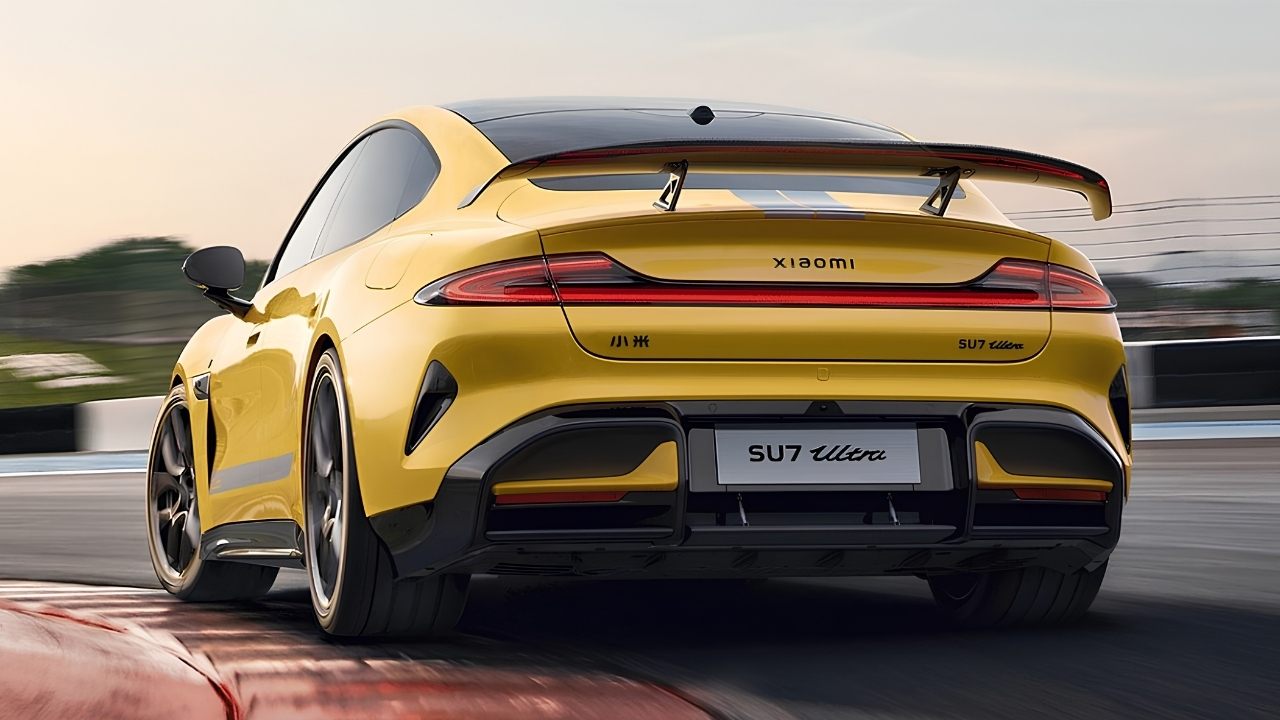
The SU7 was available as a 4-door electric sedan at that time with a seating capacity of 5 people in a 2-3 layout. The length, width, and height are 4,997 mm, 1,963 mm, and 1,455 mm, respectively, and the wheelbase is 3,000 mm. It comes with both rear-wheel drive and all-wheel drive drivetrains and two lithium-ion battery pack configurations that are 73.6 kWh and 101 kWh. When the battery pack is fully charged, it can run up to 830 km under the CLTC condition.
On the other hand, the YU7 is a mid-size electric SUV that also features a 5-person seating capacity in a 2-3 layout. It is 4,999 mm longer, 1,996 mm wider, and 1,600 mm taller. Its wheelbase is 3,000 mm. Like the SU7, it is available with both RWD and AWD drivetrains and two battery packs that are 96.3 kWh (LFP) and 101.7 kWh (NMC). Gives the CLTC range up to 835 km and can accelerate from 0 to 100 km/h in 3.23 seconds.