
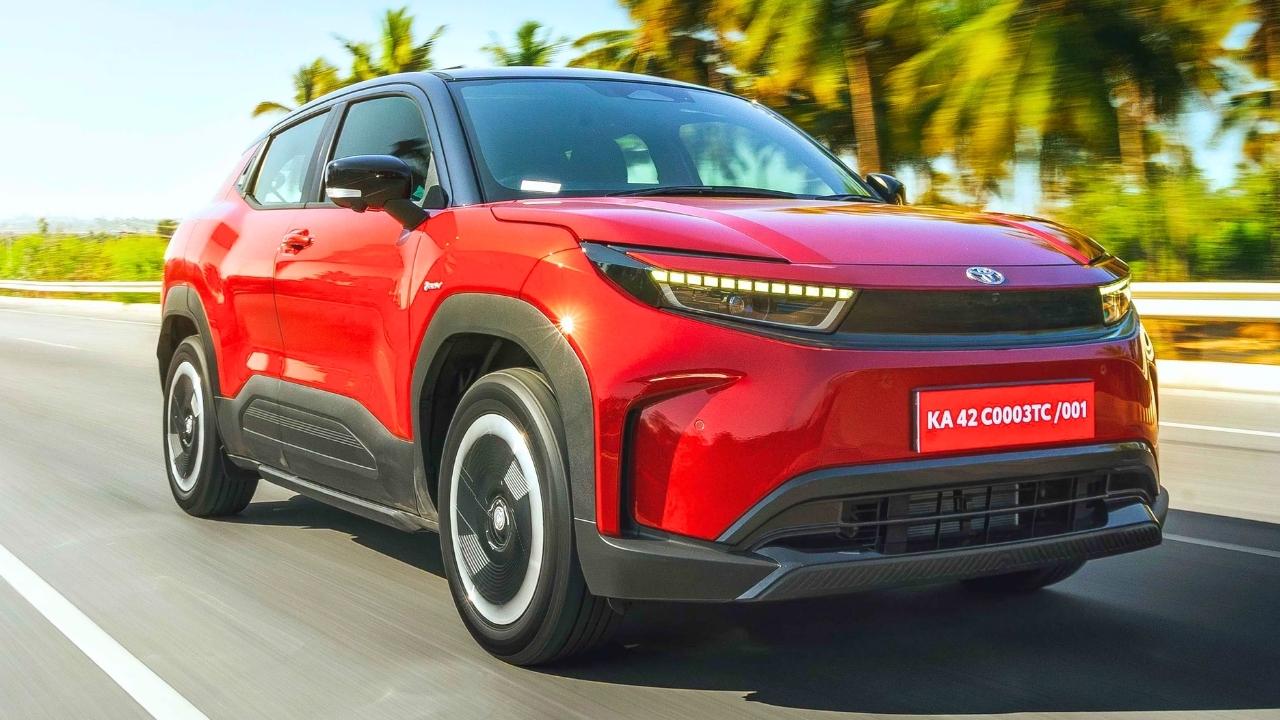
Toyota India, a subsidiary of Japanese automobile manufacturer Toyota, launched the Toyota Ebella’s E3 variant on May 29, 2026, in the Indian market with the ex-showroom price of ₹23.60 lakh. Notably, it is a rebadged version of the Maruti Suzuki e Vitara’s Alpha Dual Tone variant, which is available for sale in India with the ex-showroom cost of ₹20.01 lakh, meaning the rebadged version is ₹3.59 lakh costlier.
The carmaker will also introduce two more variants that are going to be E2, followed by the E1. Launch date and ex-showroom price for these upcoming variants are still pending; reports suggest their launch may take a few weeks. However, the booking for them is already taking place from January 2026, as the launch of the E3 variant is happening; very soon the delivery will start for it.
Notably, all three variants of the Toyota Ebella are set to be available for sale as the Battery-as-a-Service (BaaS) option. Despite the launch of the E3 variant, the carmaker hasn’t revealed the pricing breakdown. It is highly anticipated that the BaaS price for each variant is ₹4.5 lakh to ₹5 lakh lower than the actual ex-showroom price.
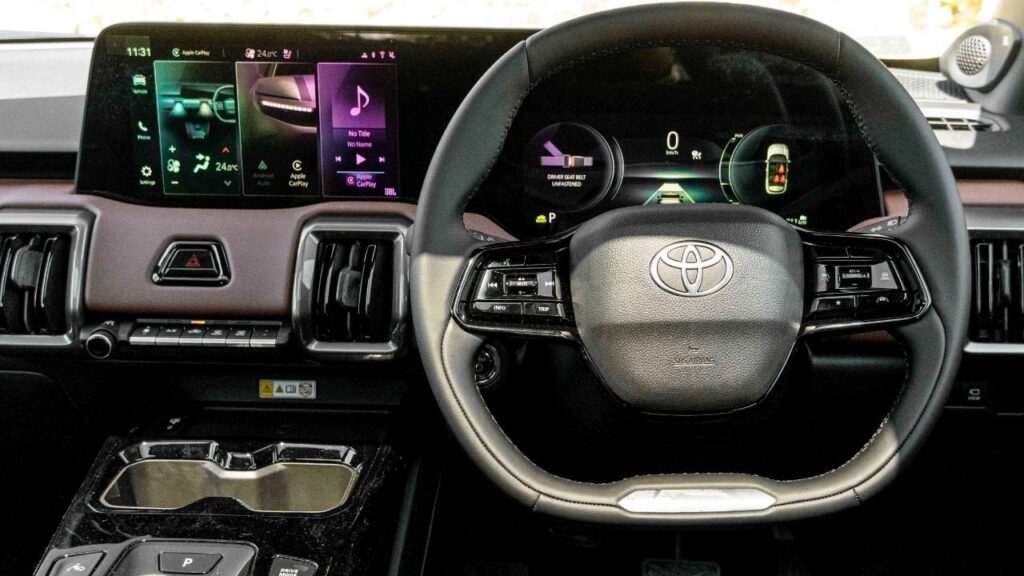
Even though the launch of E2 and E1 is pending, the specifications and features for all are already made public. Like the Vitara, the Toyota Ebella is also available with two LFP battery packs that are 49 kWh and 61 kWh. The standard battery is set to be offered with the E1 variant, and a large one is available with the recently launched E3 and upcoming E2.
The company has made the claim that with the standard battery pack, it runs up to 440 km when the battery is fully charged, but with the large battery pack, its Automotive Research Association of India certified range is 543 km. The real-world driving range was anticipated to be around 380-400 km with the standard battery but 480-500 km with the larger battery pack.
Features an all-wheel-drive drivetrain and a side single-speed automatic transmission in all the variants; the E1 variant generates the maximum power of the motor mounted with the front axle, which is 144 hp, and the E2 and E3 do 174 hp, and the peak torque is 193 Nm with both battery packs. The acceleration timing for 0-100 km/h, maximum speed, and charging details are yet to be revealed.
Some reports say that the pending specifications are expected to be the same as the e Vitara, meaning to accelerate from 0 to 100 km/h, it may take 9.2 seconds with standard and 10.5 with larger battery packs; the top speed for E1 may be 150 km/h, but E2 and E3 are likely to go up to 155 km/h. All variants may support a 70 kW charger, which takes 40-45 minutes for 10-80% charging.
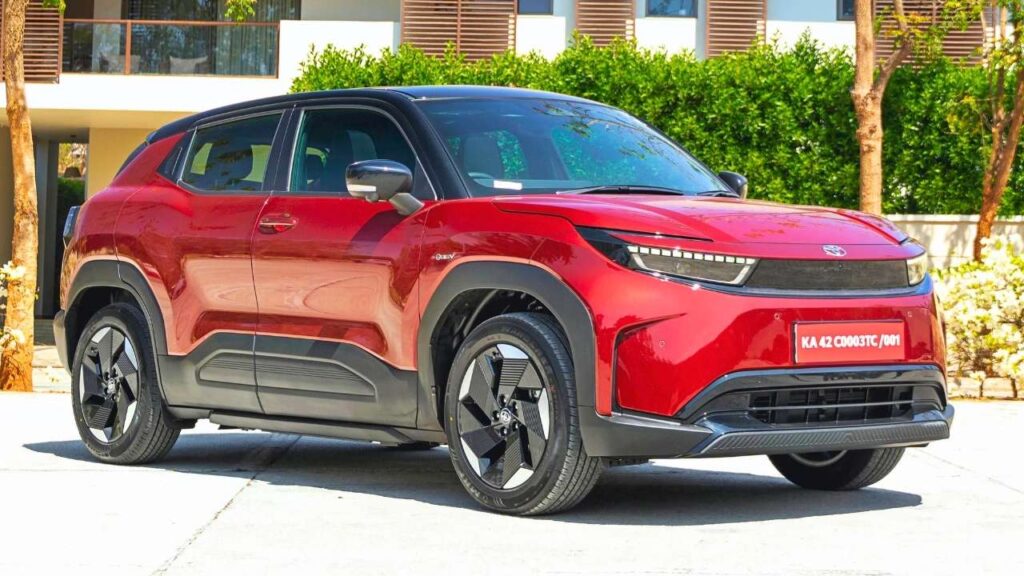
The length, width and height are 4,275 mm, 1,800 mm, and 1,640 mm, respectively. Its wheelbase is 2,700 mm, groundvit clearance is 180 mm, and turning radius is 5.2 metres. The E3 variant that launched today is equipped with 18 inches; the mid-range and entry-level are expected to get 16 inches and 18 inches, respectively. Up front, it gets triangular-shaped LED headlamps with segmented LED DRLs, a sculpted bumper with side air intakes, and a gloss-black closed-off grille.
On the sides, it features squared-off wheel arches, aero-optimised alloy wheels, mechanical door handles for the front door but the rear gets hidden door handles at the C-pillar, blacked-out outside rearview mirrors with integrated side indicators; and the rear comes with connected LED taillamps, a Toyota logo in the tailgate, an integrated roof spoiler, a shark-fin antenna, and a rugged bumper with a silver skid plate.
It is available with nine exterior colour options, including five monotone, which are Cafe White, Bluish Black, Gaming Grey, Sportin Red and Enticing Silver; and four double-tone with a black roof and Cafe White, Land Breeze Green, Sportin Red and Enticing Silver as the body colour. Available with a seating capacity of 5 people in a layout of 2-3, and it has a boot space of 310 litres, the same as the e Vitara. Its main competitors are Hyundai Creta Electric, Mahindra BE 6 and VinFast VF 6.