
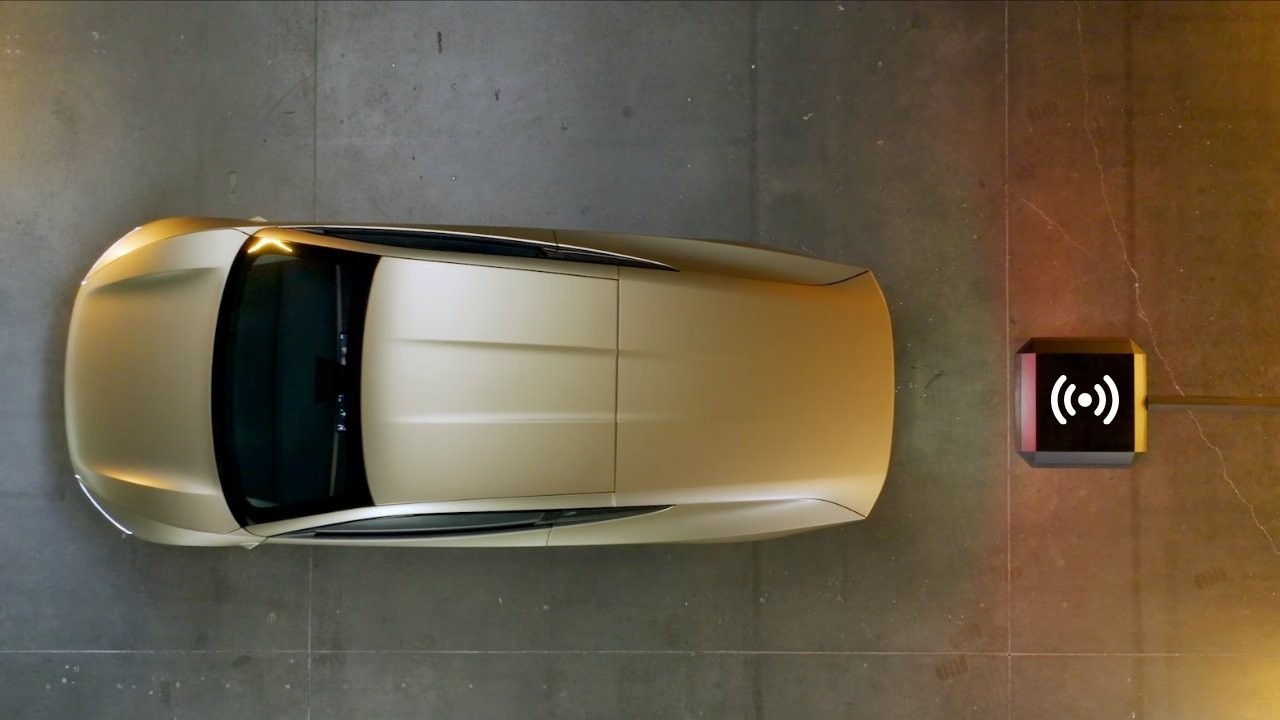
The US Federal Communications Commission has finally granted approval to Tesla, an American electric vehicle manufacturer, to use Ultra-Wideband (UWB) radio technology in their wireless EV charging system. It means now the carmaker can introduce the Tesla Cybercab to the domestic market as a fully autonomous robotaxi, which won’t only be capable of running on public roads across the country but also charging itself without any human involvement.
You may be wondering what the UWB radio technology is and how Tesla is going to use it in their wireless EV charging system, with which the Cybercab is all set to make its debut in the country. You may have read reports quoting it as the ‘UWB Tesla EV wireless charging system’; factually, it is totally wrong. The ‘UWB’ and ‘Tesla EV wireless charging system’ are two different things, but without the first, the second one’s automation is impossible. Let’s have a closer look.
The UWB radio technology is a tech that is used for short-range wireless communication. Notably, it uses a bandwidth with a very wide radio frequency, which helps in measuring the location and distance with great precision with centimetre calculations. Basically it is capable of measuring and locating devices with an accuracy of ±10 mm to ±30 mm, which is way better than Bluetooth and GPS.
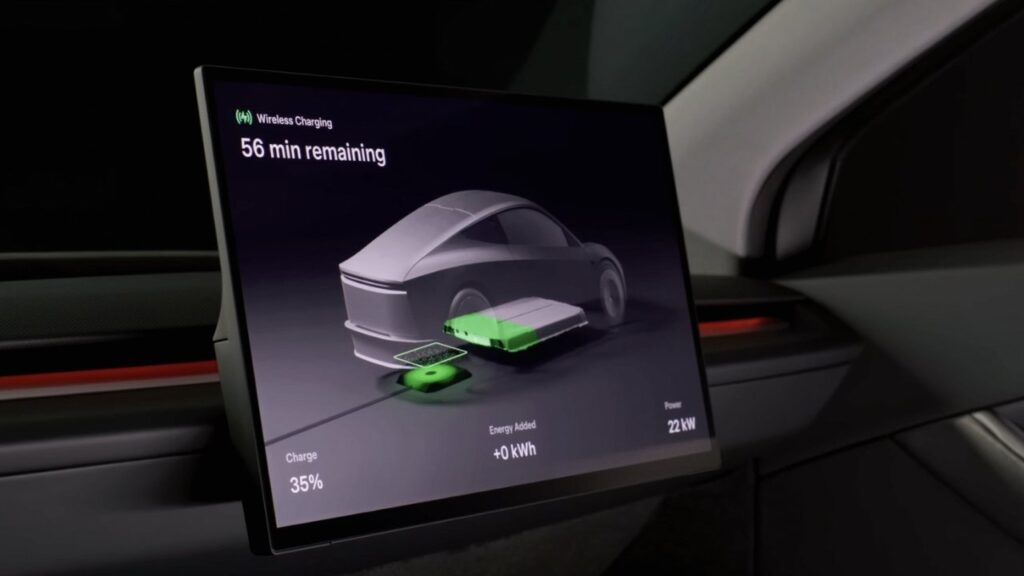
Using this technology in the upcoming Cybercab, the Tesla is set to make the vehicle stand in near-possible alignment with the charge pad without any manual involvement so the EV charges itself efficiently. Meaning, the UWB radio technology is tech which will help the upcoming Tesla’s compatible EV to align with the charging pad to charge it automatically without any human input.
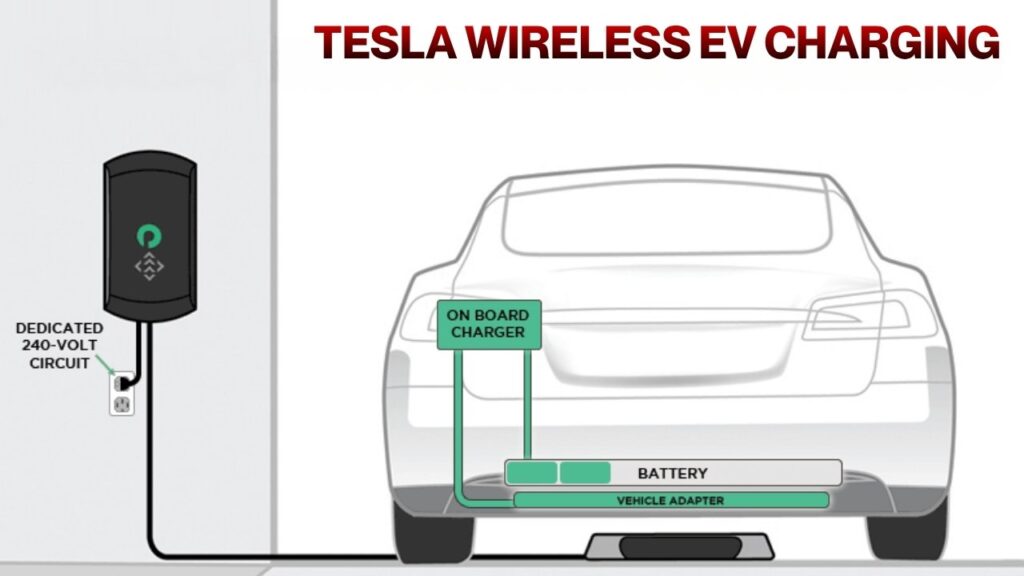
On the other hand, the Tesla wireless EV charging system is a convenient way of charging an EV without plugging-in. The system includes a ground-mounted charging pad that is connected with an electric grid. For charging, the compatible electric car aligns its charging spot, underpinned beneath the floor, with the wireless charging pad using the equipped UWB radio technology.
Tesla Cybercab: What do we know so far about it?
The Tesla Cybercab is set to be the first electric vehicle from the American carmaker that will come with the wireless EV charging feature integrating UWB radio technology. They unveiled it as a fully autonomous robotaxi back in October 2024, which does not have any steering wheel or paddle. They won’t only introduce it as their own robotaxi fleet but also launch it for personal use to individuals.
Reportedly, the production is taking place at Gigafactory Texas, and the launch is expected by late 2026. There’s no official confirmation regarding the price, but for individuals it is anticipated to be available for less than the price of $30,000, which translates to ₹28.64 lakh. It is set to come with a seating capacity of two people with two side, wing-like opening doors.
Upfront, it gets a closed-off grill with Cybertruck-inspired futuristic styling for better aerodynamics; full-width LED daylight running lights that connect with main headlights add a modern touch and make it catchy. On the side, it features large aero-optimised alloy wheels, giving bold road presence, and its frameless doors enhance premiumness. And at the back, it boasts a hatchback-style cargo opening for easy boot access, and a full-width taillight creates a wide stance, making it different from others.
Inside, it features large legroom for two people. The cabin is equipped with a large touchscreen infotainment system at the centre of the dashboard that will support wireless connectivity. It does have a central console, at the place of which there are two cup holders, which are added for occupants’ convenience. Details regarding its battery pack and range are also pending; some reports suggest it may get a 50 kWh LFP battery pack, giving a range around 300 miles, which translates to 483 km.
