

BYD’s subsidiary Fangchengbao has finally released the official image for the upcoming full-size plug-in hybrid electric sport utility vehicle, Fangchengbao Ti9, on August 10, 2026, after its appearance in the China MIIT catalogue filing release. In the near future, they will start the pre-sale, and then the market launch will take place.
The upcoming six-seater PHEV under the banner of Fangchengbao is set to be positioned above the Ti7. Following the launch, it will become the third vehicle in the Ti series. So far, BYD is selling four vehicles under the banner of FCB, and the upcoming one will add the 5th. Besides the Ti series off-roading vehicles, there are two Bao models, 5 and 8.
Rugged Appearance
Outside, the Ti9 has full-width double LED daylight running lights with main headlamps at the edge, a Fangchengbao logo in the center between the DRL strips, a closed-off body-colored grille, a silver skid plate on the bumper, lower active air intakes at the front end, squared-off black wheel arch cladding, lower body cladding, and large alloy wheels.
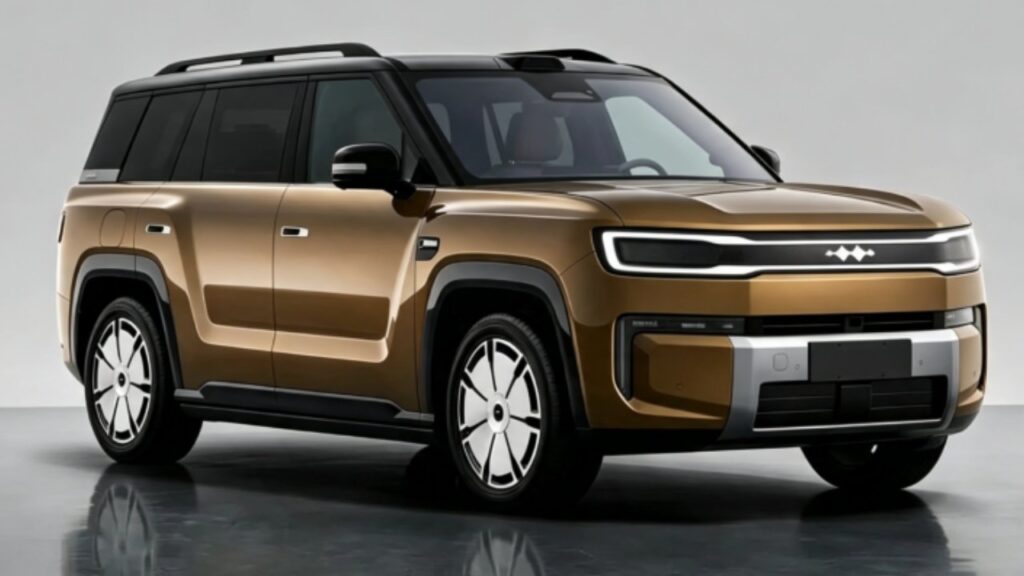
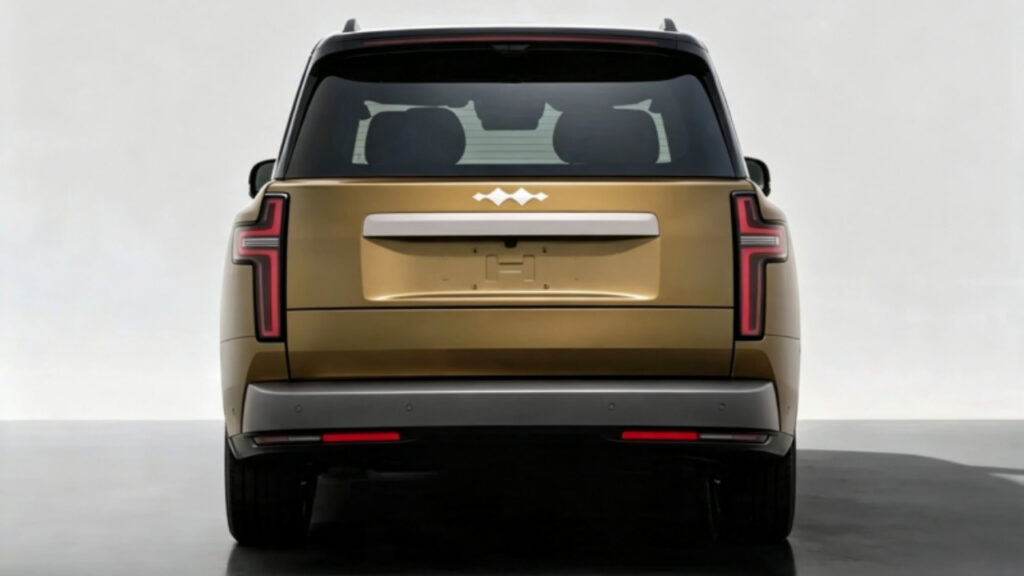
Other notable features on the exterior are front-door-mounted outside rear-view mirrors, which also have integrated blinkers; flush-type handles; black-outed A, B, C, and D pillars; roof-mounted tails; a roof-integrated spoiler; vertically oriented LED taillamps; an FCB logo on the tailgate; a bumper-integrated side reflector in a horizontal shape; and a rugged rear bumper.
Core Specifications
As a six-seater PHEV in a 2-2-2 arrangement with captain’s seats in the middle row, the Ti9 measures 5,270 mm in length and 1,999 mm in width. Two different height options are revealed via the China MIIT filing, which are 1,850 mm and 1,880 mm, 30 mm more than the standard one. The wheelbase, the distance between axles, is 3,130 mm.
The curb weight ranges from 2,865 kg to 2,965 kg, depending on variant, but the gross vehicle weight is 3,495 kg. Under the hood, it has a 1.5-liter four-cylinder turbocharged petrol-powered internal combustion engine, whose gross and net power output is 115 kW and 110 kW, respectively. Set to feature a 2,000 kg towing capacity with an optional electric tow hook.
Two wheel size options will be available; they are 21 and 22 inches. Equipped with two electric motors, one is available on each axle, and they both have a maximum power output of 200 kW; the rated power for the one mounted on the front axle is 90 kW, and the same for the rear axle mounted is 70 kW; the combined power output is still pending. Its top speed is 220 km/h.
Pure Electric Range
The plug-in hybrid electric vehicle does have a battery electric under the floor; it gets an in-house built next-generation Blade lithium-ion battery pack whose capacity is 66.48 kWh. When the battery pack is fully charged, it can run up to 310 km on the CLTC condition. The real-world range depends on driving style and road condition.
BYD has already confirmed that all BYD Blade 2.0 LFP battery packs are capable of supporting megawatt-level charging. Therefore, the upcoming PHEV is set to support ultra-fast DC charging, which takes 5 minutes for 10 to 70 percent charging and 9 minutes for 10 to 97 percent. In case of extreme cold, it takes 12 minutes for 10 to 80 percent.
Premium Features
Equipped with the DiPilot 300 (God’s Eye B), BYD’s latest advanced driving assistance system, which features navigation autopilot for both city driving and highway cruising, lane centering, adaptive cruise control, and other smart features using the roof-mounted LiDAR, sensor, and camera.
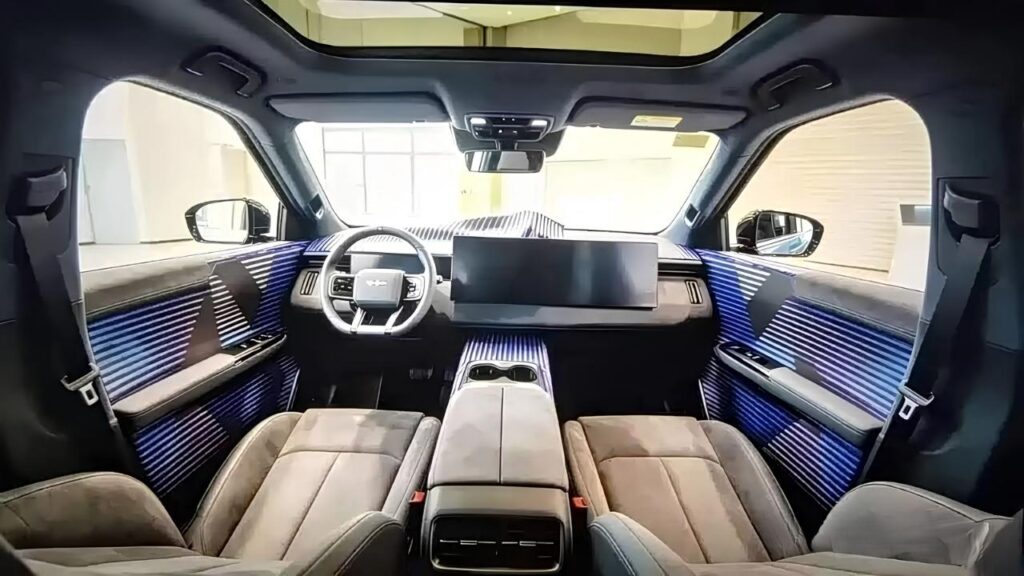
They are yet to release the interior images officially. But the spy shots of the cabin reveal it has a four-spoke steering wheel and a slim digital instrument cluster behind it. The dashboard has a long touchscreen, which integrates both an infotainment system for the driver and an entertainment screen for the co-passenger.
Its center console, which is between the co-passenger and driver seats, has two wireless phone charging pads, two cup holders, and a hidden storage compartment. The end of the center console visible from the second row has a USB charging port and rear AC vents to enhance comfort.
