
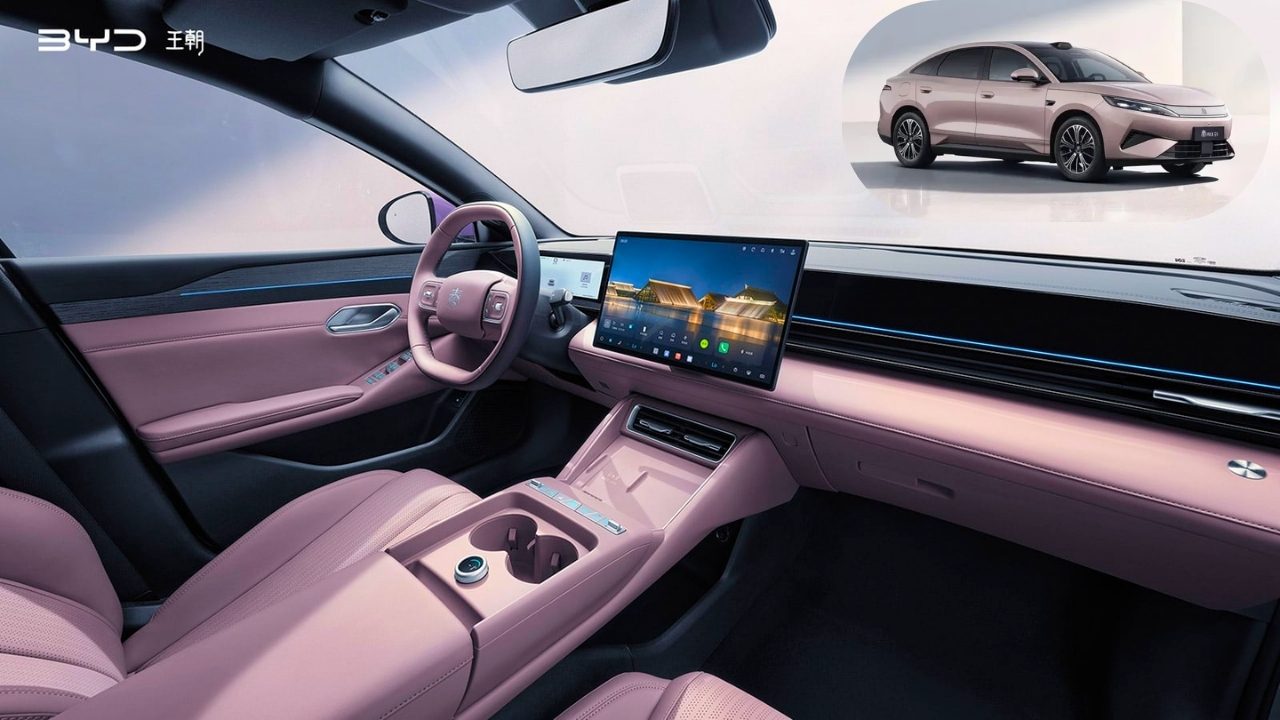
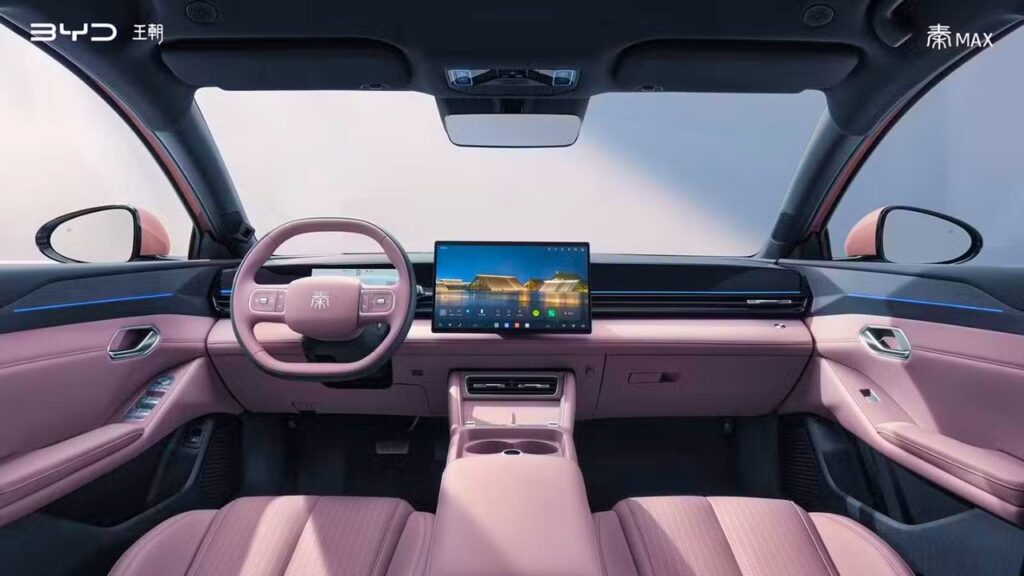
After revealing the exterior of the BYD Qin Max, an electrified B-segment sedan. It has a wrap-around dashboard with chrome accents to enhance the cabin’s aesthetic, a two-spoke multi-function steering wheel with physical buttons, and a BYD logo in ‘Chinese,’ which is all set to show the following:
- Vehicle speed
- Battery charge level
- Remaining driving range
- Power or energy consumption and regeneration
- Tire Pressure Monitoring System information
- Warning and indicator lights
- Outside temperature and time
The center of the dashboard has a floating, horizontally oriented touchscreen infotainment system, which will show navigation with real-time route guidance. It is set to support Bluetooth connectivity, wireless smartphone connectivity, over-the-air software updates for connected car technology, and an artificial intelligence-based voice assistant.
Notably, the size of the digital instrument and infotainment system screen is still pending; the one before the driving seat is anticipated to be around 8.8 inches, and the other one just above the center console is expected to be 15.6 inches.
The center console has air-conditioning vents to keep the co-passenger and driver cool in summer and warm in winter; two wireless phone chargers for the convenience of individuals seated in the front row; physical buttons for control and better practicality; and two cup holders to enhance the convenience inside the cabin.
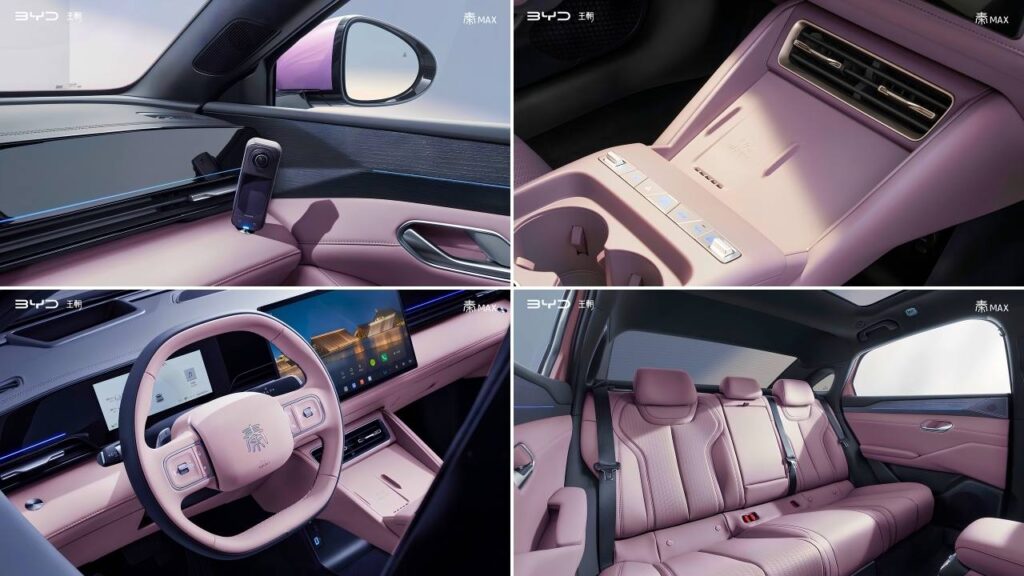
Its ceiling in the first row gets inside the rearview mirror to see through the windshield. For the first two seats, the armrest is available in the center based on the side of the door.
The interior image they have released also includes the second-row photos; it clearly shows there are three seats in a bench-like structure with separate headrests to enhance seating comfort. Its second row also has an armrest on the door to enhance seating comfort for individuals seated on the sides.
The cabin looks spacious and can easily accommodate five adults with ample legroom, headroom, and shoulder room. To enhance the comfort and convenience for the driver and co-passenger, the front seats are expected to be heated and ventilated and may also be electronically adjustable.
The boot space image isn’t yet revealed. It is certain that behind the second row, the cabin will have a large cargo space to carry luggage. The second-row seats are set to be foldable, which significantly increases the boot space and makes it easy and convenient to carry big luggage.
Media reports confirm that the model will arrive at dealerships by late 2026, and then the presale may start. Notably, the carmaker is all set to introduce the vehicle as an EV and PHEV. The electric vehicle will debut in five variants with the price of 125,000 yuan and 155,000 yuan (₹17.82 lakh to ₹22.10 lakh), and the plug-in hybrid electric vehicle in four trims between 115,000 yuan and 145,000 yuan (₹16.40 lakh to ₹20.68 lakh).
Reports even claim that the market launch of the model will take place on August 13, 2026, in China. It is most anticipated that the launch price will be a little less than the pre-sale amount. Now, they have officially confirmed that the EV version will get next-generation Blade LFP battery pack supporting ultra-fast DC charging, which takes 5 minutes for 10 to 70 percent charging.
The electric vehicle will come with two different lithium-ion battery packs that are 52.868 kWh and 64.315 kWh LFP. The power output of the former one is 120 kW (161 hp) and the CLTC range is 530 km, and the latter one delivers a 240 kW (322 hp) output, giving a range of 630 km; plug-in hybrid electric vehicles get a 1.5-liter NA-petrol ICE with a single electric motor, whose combined power output is 249 kW (334 hp).