
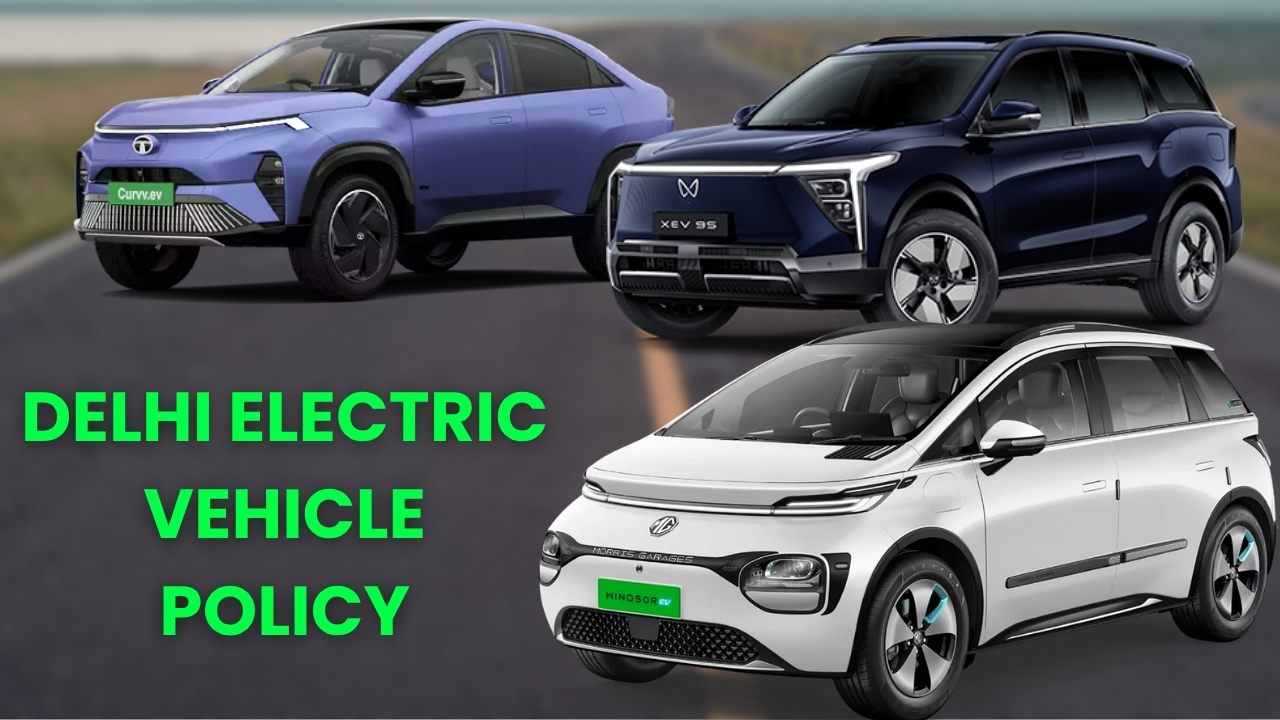
The Government of Delhi has released the draft electric vehicle policy for 2026-2030 and asked for feedback from the public within a time duration of 30 days, with a deadline of May 10, 2026. It includes incentives with some strict rules; the aim of the policy is to promote future mobility and also keep the national capital’s environment clean.
The drafted Delhi EV policy isn’t only for private vehicles but also for the commercial ones. It’s important to understand what the government of Delhi has proposed. Here, we have discussed everything you are looking for.
What does the Delhi EV draft policy say about electric cars?
In New Delhi, there’s no subsidy on purchasing an electric car with any price tag. But the draft says that all e-cars with an ex-showroom price under ₹30 lakh won’t attract any road tax and registration fee until 2030 in the national capital. The e-cars available in the Indian market with ex-showroom prices under ₹30 lakh are the following:
Tata Motors
- Tiago.ev: ₹7.99 to ₹11.14 lakh
- Punch.ev: ₹9.69 to ₹12.59 lakh
- Tigor EV: ₹12.49 to ₹13.75 lakh
- Nexon.ev: ₹12.49 to ₹17.49 lakh
- Curvv.ev: ₹17.49 to ₹22.24 lakh
- Harrier EV: ₹21.49 to ₹30.23 lakh
Mahindra & Mahindra
- XUV 3XO EV: ₹13.89 to ₹14.96 lakh
- XUV400 EV: ₹15.49 to ₹17.69 lakh
- BE 6: ₹18.90 to ₹28.49 lakh
- XEV 9S: ₹19.95 to ₹30.20 lakh
MG Motor
- Comet EV: ₹7.00 to ₹9.78 lakh
- Windsor EV: ₹14.00 to ₹18.50 lakh
- ZS EV: ₹17.99 to ₹20.50 lakh
Hyundai
- Creta Electric: ₹18.02 to ₹24.70 lakh
BYD
- Atto 3: From ₹24.99 lakh
- eMAX 7: ₹26.90 to ₹29.90 lakh
Maruti Suzuki
- e-Vitara: ₹13.49 to ₹17.26 lakh
Kia
- Carens EV: ₹17.99 to ₹24.99 lakh
Citroen
- eC3: From ₹12.70 lakh
VinFast
- VF 6: From ₹17.29 lakh
- VF 7: ₹21.89 to ₹26.79 lakh
A scrappage benefit of ₹1 lakh is available; you can claim it by getting your BS-IV or old vehicle scrapped and buying a new electric car for private use. Note that it will be available for only the first 100,000 buyers.
Hybrid Car Policy
As per the Delhi electric vehicle draft policy, there’s also no incentive to buy a hybrid vehicle, and there’s even no scrappage benefit for them.
Although the hybrid cars with ex-showroom prices up to ₹30 lakh are all set to get a 50% exemption from road tax and registration fees until 2030. In the Indian market, the hybrid cars with the ex-showroom price under ₹30 lakh are
- Maruti Suzuki Grand Vitara: ₹18.43 to ₹20.09 lakh
- Toyota Urban Cruiser Hyryder: ₹16.66 to ₹20.19 lakh
- Honda City e:HEV: ₹19.04 to ₹20.55 L
- Maruti Suzuki Invicto: ₹25.21 to ₹28.92 lakh
- Toyota Innova Hycross: ₹25.97 to ₹30.98 lakh
- Maruti Suzuki Victoris: ₹10.50 to ₹19.99 lakh
Electric 2WS Policy
Under the Delhi EV policy draft, it is mentioned that on the purchase of electric two-wheelers, i.e., motorcycles or scooters, one will get an incentive, which depends on the battery size. Refer to listed points for more details.
- For the 1st year after the implementation of the new EV policy, you can get an incentive of ₹10,000 per kWh battery with a cap of ₹30,000.
- For the second year and third year, the incentive amount will be reduced to 6,600 per kWh with a cap of ₹20,000 and 3,300 per kWh with a cap of ₹10,000, respectively.
To get the incentive for buying an electric two-wheeler, it is mandatory that its ex-showroom price not exceed ₹2.25 lakh. The scrappage benefit is also available for it; if you get scrapped any BS-IV emission two-wheeler or older and buy a new electric bike or electric car for personal use, you can get ₹10,000. Note that after April 1, 2028, no petrol-powered 2W will be registered in the capital city.
Delhi EV Policy For 3Ws & Goods Carries
Under the 2026-2030 Delhi EV draft policy, it is clearly mentioned if anyone buys a three-wheeler electric vehicle such as an auto after the implementation of the policy, he/she will get ₹50,000, ₹40,000, and ₹30,000 in the first, second, and third year, respectively.
The electric-powered goods carrier, which comes under the N1 category, will get an incentive of ₹1 lakh in the year the policy will be implemented, but in the following years it will be reduced to ₹50,000 and then to ₹25,000. It is also notable that after January 1, 2027, no ICE three-wheelers will be allowed to be registered in the national capital.
