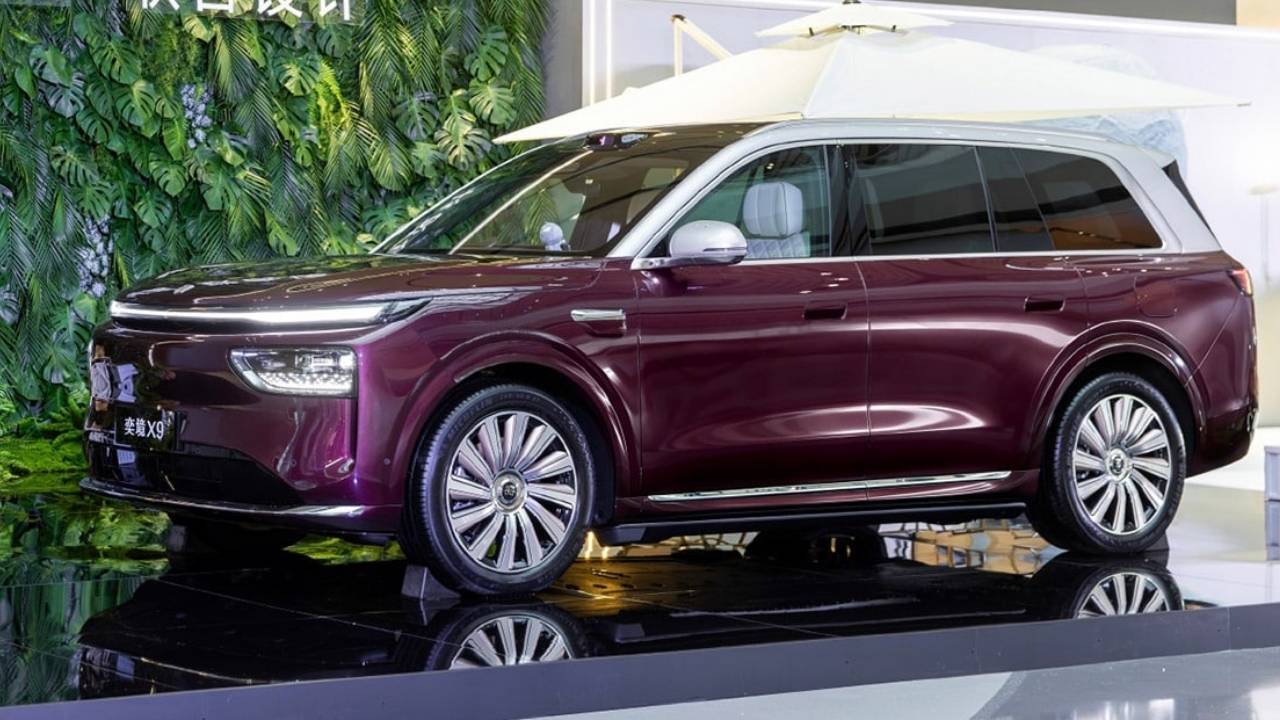
Epicland, the sub-brand from Dongfeng, will soon launch an Epicland X9, a six-seater extended-range electric SUV, in the Chinese market. On August 19, 2026, they started taking pre-orders from the integrated buyers. They have introduced a total of three variants, whose prices are as follows.
- Max Edition: 299,800 yuan (44,970 USD)
- 4WD Ultra+ Long Range: 339,800 yuan (50,970 USD)
- 4WD Ultra+ Flagship Long Range: 379,800 yuan (56,970 USD)
This upcoming electrified SUV makes its public debut at the 2026 Being Auto Show. As of now, there is no confirmed date for its market launch, but we are expecting it to happen in September 2026 because many brands in China launch models within a month after starting the pre-sale. Let’s have a closer look at its specs and features.
Starting with its exterior. Outside, it has a slim, full-width daylight running light, which improves its daytime visibility. The main headlamp, which illuminates the road for nighttime driving, is placed on the side below the DRLs strip. The sides have pronounced wheel arches for styling.
The ORVMs also integrate blinkers; they are mounted on the A-pillar. The door handles are semi-hidden to reduce drag; it also adds premiumness to the side view. Chrome’s garnish on the window further enhances its profile view. Other details on the exterior include a full-width LED tailgate giving more rear view and a roof-integrated spoiler helping with enhanced stability on the highlights.
Its dimensions in terms of length and width are 5,301 mm and 2,015 mm, respectively; the height is 1,820 mm for RWD and 1,805 mm for AWD. The wheelbase for both is 3,120 mm. Compared to Li Auto L9 and AITO M9, it has a 15 mm and 10 mm longer wheelbase, respectively, but is 5 mm shorter than Denza N9 and 49 mm shorter than Zeekr 9X.
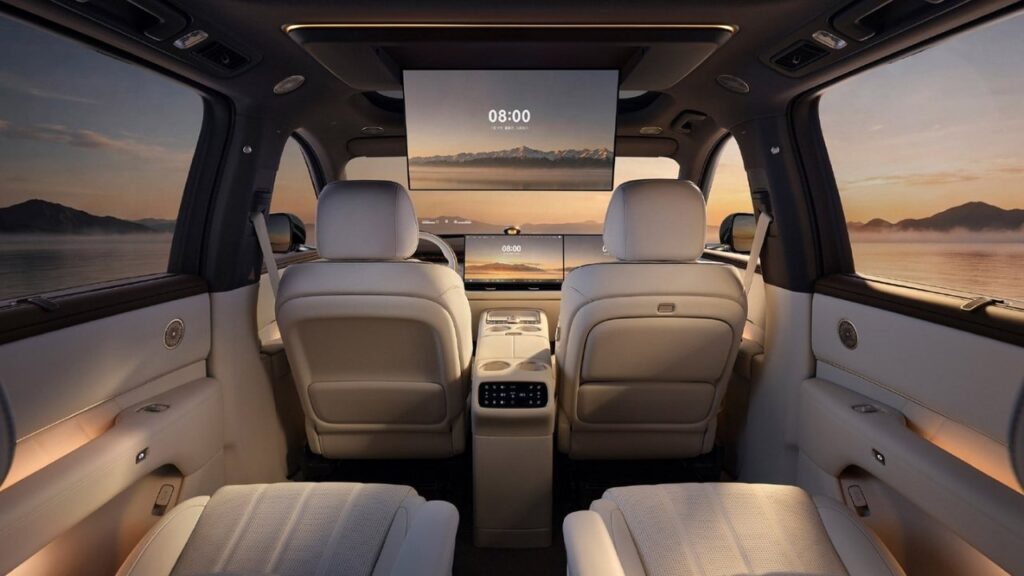
Moving inside. Six seats inside the cabin are available in a 2-2-2 layout. Notably, the second row has a captain’s chair featuring separate armrests and leg support for enhanced comfort. For better practicality with carrying luggage, a boot space of 484 liters is available when all seats are used. The third-row seats support flat folding, which enhances the cargo capacity to 1,368 liters.
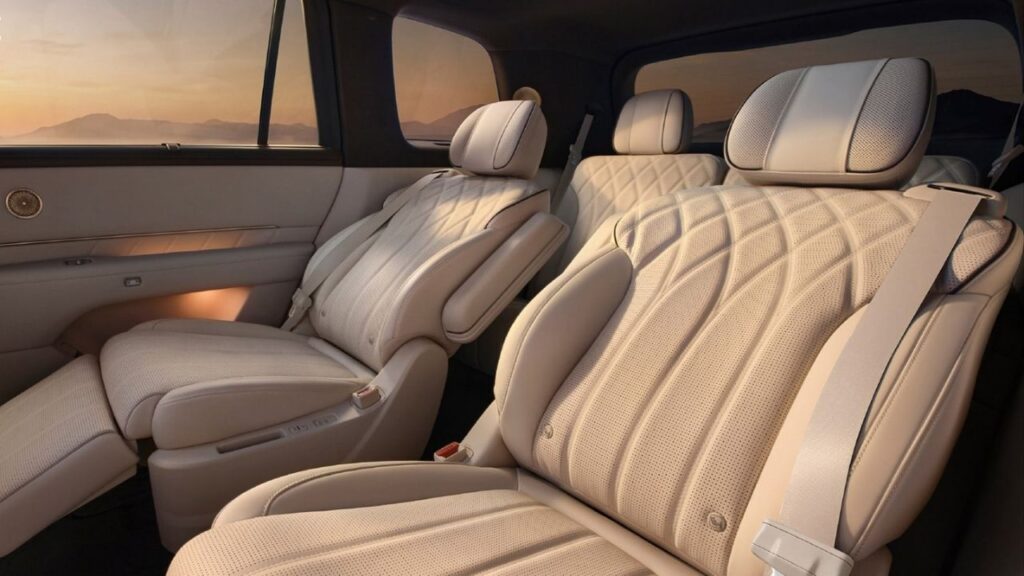
The second-row seats have zero gravity for premium comfort, and the front passenger seat is named the Queen seat. The center console, present between the front seats, has four cup holders, a hidden compartment, and two wireless smartphone charging pads. The circular three-spoke steering wheel’s column gets a gear selector.
Its dashboard has a 17.2-inch dual-linked “Butterfly Wing” display; one is mounted at the center of the dashboard as an infotainment system, and another is before the co-passenger seat as an entertainment display. These screens have 3.4K resolution and a 98% DCI-P3 color gamut, which runs on the HarmonySpace 6 cockpit.
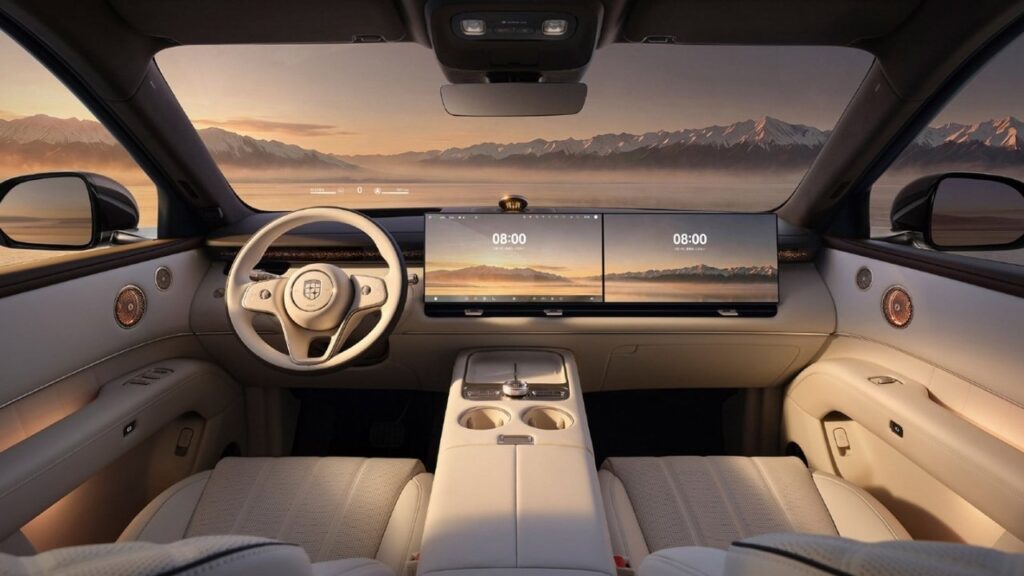
The cabin’s row also gets a built-in wind-cooled compressor refrigerator with cooling up to -6°C to heating up to 50°C. It helps with carrying beverages and edibles. Under the steering, there’s a digital instrument cluster beside it that also has a HUAWEI XHUD augmented-reality head-up display that shows driving data on the windshield.
Talking about the tech end. The Epicland X9 is equipped with the Huawei Qiankun ADS, Huawei’s latest advanced driver-assistance system, combining 896-line dual-optical-path imaging LiDAR, three high-precision solid-state LiDARs, and distributed 4D millimeter-wave radar, and featuring navigation-assisted driving and intelligent route planning.
Lastly, shifting focus to its powertrain and performance. As an EREV, it is a 1.5-liter four-cylinder turbo-petrol ICE and one electric motor on the rear axle for RWD and two, one on each axle, for the AWD variant, with a 74.29 kWh CATL LFP battery giving the CLTC range of 465 km, but the real-world range for city driving is around 380 km in EV mode; on the highway it may run up to 405 km.
When the battery charge depletes, the internal combustion engine acts as a generator to power motors. The combined range, meaning when the battery pack is fully charged and even the tank is full, it runs up to 1,500 km on the CLTC condition; the real world is affected by different factors. More of its core specifications are yet to emerge with the market launch in China.