
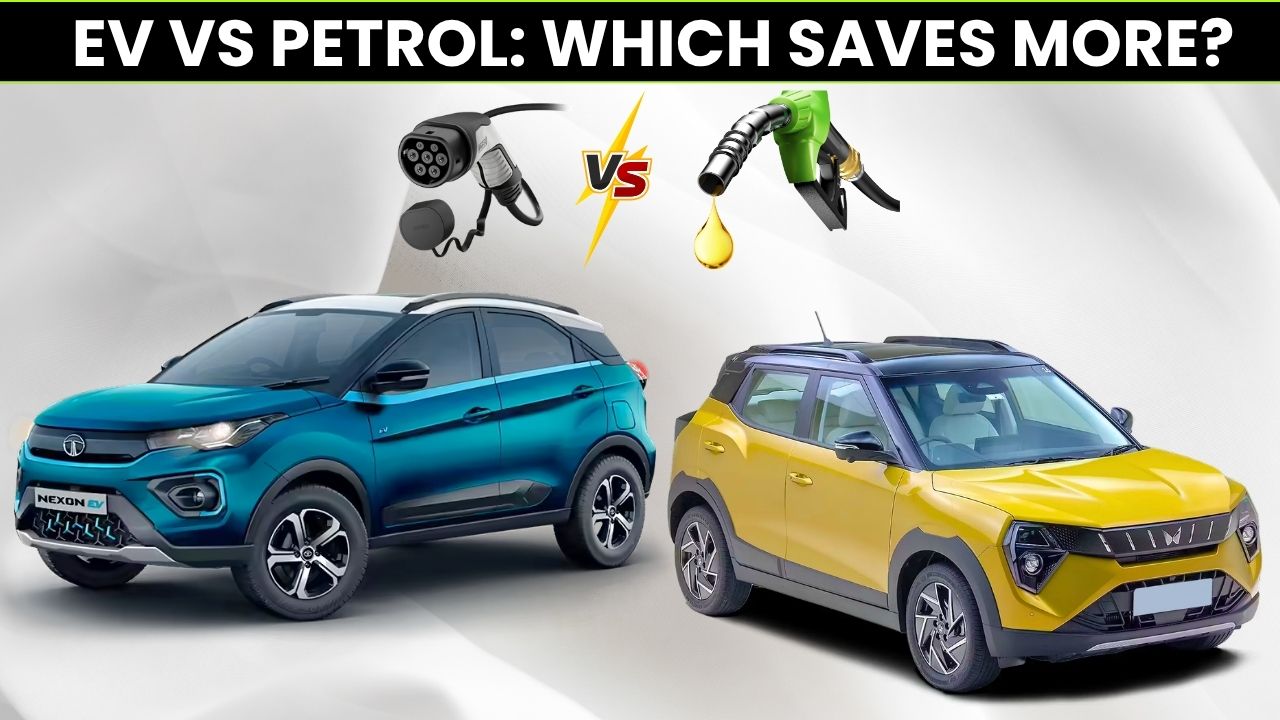
You may often hear in the media, from automotive experts, and from surrounding people that electric vehicles save thousands of rupees monthly in driving compared to petrol-powered internal combustion engine cars. Anyone who’s planning to buy an EV or just interested in knowing about the reality behind this claim should know that the reality is something else; read this article thoroughly and get answers to all your questions regarding it.
Running Cost
Let’s begin with the running cost; notably, a petrol-powered ICE car runs around 15 km with 1 litre of petrol, and an EV consumes 1 kWh of electricity for a drive of 8 km. With a monthly average driving of 1500 km, an ICE vehicle consumes 100 litres, and the EV’s electricity consumption for the same distance is 187.5 kWh.
As of now, the average national price of petrol is ₹110 per litre, and the EV charging of 1 kWh costs ₹20 at public charging stations. So the monthly expenses for driving 1500 km with a petrol-powered ICE car are ₹11,000, but the same for an electric vehicle are only ₹3,750. Meaning, by having an EV with 50 km of daily average driving distance, one can save up to ₹7,250.
Notably, charging an EV using the AC charger is more affordable; with home charging, it costs only ₹8 for 1 kWh charging. For 1500 km of monthly driving, one needs to spend only ₹1,500 monthly. If you compare it to a petrol-powered ICE car, it saves 9,500, which translates to 86.36 per cent of 11,000.
Maintenance Expenses
We know that the car needs maintenance, which one also has to spend money on. After going through the breakdown of running costs, now we are moving to maintenance expenses. The petrol-powered car has an ICE, which has thousands of moving parts; they require timely changes of engine oil, oil filters, air filters, and spark plugs. Reportedly, the annual service cost of the same is ₹8,000, meaning the monthly expenses are around ₹667.
But the electric vehicle doesn’t have an engine; due to a simple drivetrain, it doesn’t need maintenance like traditional cars. The owner only has to check some components regularly; these include the battery management system, coolant, brake fluids, and cabin filters. The annual cost of the same is around ₹4,000, half of the petrol car, meaning the monthly expenses for the maintenance of electric vehicles are roughly ₹336.
After going through the comparison between EVs and petrol cars in terms of running cost and maintenance expenses, you may be thinking that having an EV really saves money. Okay! We are moving to their comparison in terms of purchase cost and insurance charge, and then we will calculate its total cost of ownership (TCO).
Purchase & Insurance Cost
In India, an entry-level SUV with a powerful engine, a better fuel tank, and smart features costs around ₹11 lakh, but when you look for an EV with the same seating layout and features, it costs ₹19 lakh, meaning buying an EV is costlier. The gap we are talking about is real; you yourself checked that the traditional Harrier SUV ex-showroom price is ₹12.89 lakh, and the EV counterpart of the same costs ₹21.49 lakh.
Compared to traditional petrol-powered cars, the insurance cost for electric vehicles is very expensive. The annual insurance cost for a petrol-powered car is ₹15,000 to ₹28,000, but for the EV, it is in the same range from ₹18,000 to ₹35,000, meaning the difference is ₹3,000 and the maximum is ₹7,000.
Total Cost of Ownership
The total cost of ownership is calculated by analyzing different factors that include running cost, maintenance expenses, purchase and insurance costs, and resale value. We already have discussed the first three factors; for reference, note that the ICE car loses resale value by up to 40 percent, but the EV is deprived of a maximum of 60 percent of its resale value.
Meaning, after releasing an ICE car after 5 years of use, you can still get 60% of the purchase price, but hardly 40%. As of now, we have all the details, so let’s calculate the TOC for a petrol car and EV in India.
| Cost Component | Petrol ICE Vehicle | EV (Home Charge) | EV (Public Charge) | Calculation Basis |
| Purchase | ₹11,00,000 | ₹19,00,000 | ₹19,00,000 | Ex-showroom price |
| Running Cost | ₹6,60,000 | ₹90,000 | ₹2,25,000 | 90,000 km total |
| Maintenance | ₹40,000 | ₹20,000 | ₹20,000 | 5-year total |
| Insurance | ₹1,07,500 | ₹1,32,500 | ₹1,32,500 | 5-year average |
| Resale Value | -₹6,60,000 | -₹7,60,000 | -₹7,60,000 | Estimated depreciation |
| Net TCO (5 Years) | ₹12,47,500 | ₹13,82,500 | ₹15,17,500 | Sum of above |
Now, it’s clearly visible that having an ICE car for over the 5-year period of time saves ₹135,000 and ₹270,000 compared to an EV that runs on dependent public charging stations and home charging, respectively.
