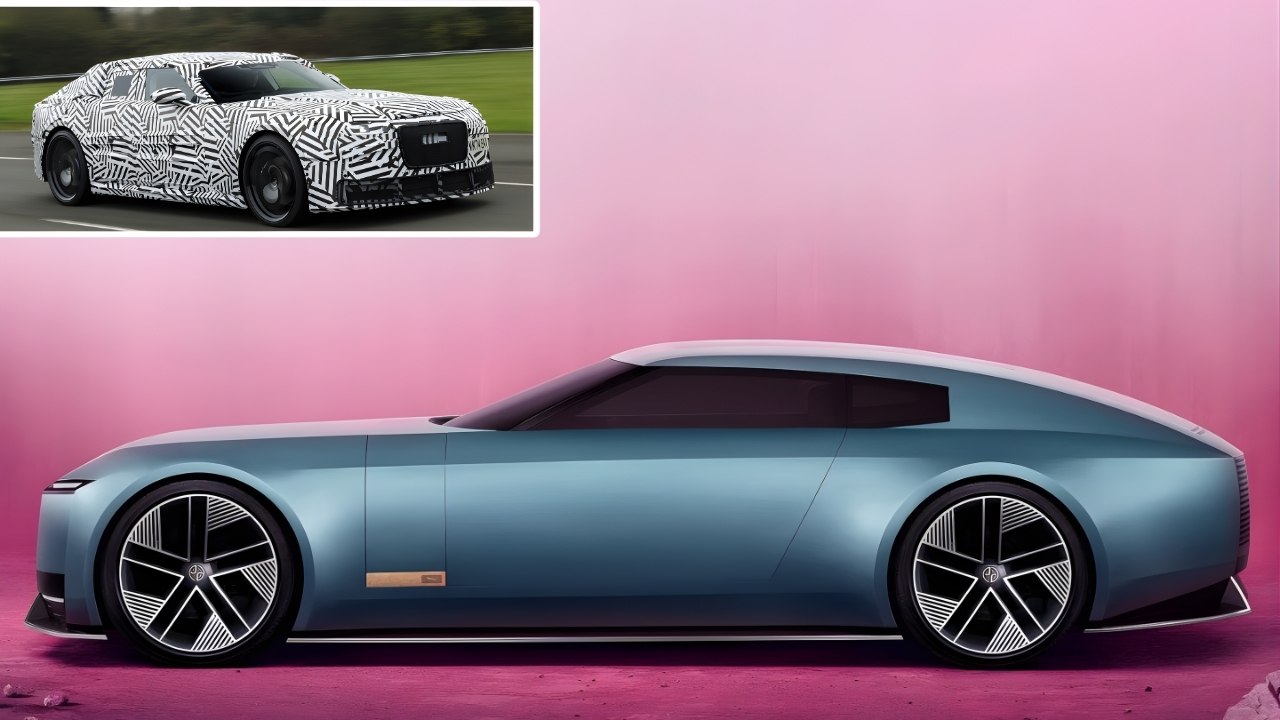
The Jaguar, a British automaker, is all set to launch its first electric vehicle that is based on the Type 00 concept, which was revealed back in the year 2024. Its global debut is expected to take place in 2027, which is based on Jaguar’s electric architecture.
Reports say that in the United States, it is expected to be introduced with a starting price of $130,000, and for the top trim, the cost may be around $160,000. If the India launch happens, it may be available with the ex-showroom price between ₹2.5 and ₹3 crore.
The name of Jaguar’s first EV may be revealed near launch, although now it is referred to as Jaguar Electric GT. In the global market, it will compete with premium luxury EVs such as the Porsche Taycan, Audi e-tron GT, Mercedes EQS, BMW i7 and Lotus Emeya.
What do we know about its design?
As the Jaguar Electric GT is based on the Type 00 concept, the design is going to be inspired by it. It is likely to feature bold, dramatic, and unconventional styling inspired by the art, architecture, and luxury objects. Instead of standard EV styling, it will feature a strong, sharp, and imposing look.
It is all set to get a very long bonnet, low roofline, pushed-back cabin, and fastback rear profile which will give it a premium and powerful stance and create an emotional appeal. The front fascia gets a minimal grill for styling, sharp and slit-like lighting elements, and strong horizontal lines.
On the sides, it gets clean and monolithic surfaces and flush-type door handles with minimal cuts, which give it a sculpted and futuristic look and improve aerodynamics. The rear will feature a full-width light bar hidden within the design with no traditional rear window and a strong horizontal theme.
How would its interior be?
The interior is likely to feature a clean and uncluttered layout with almost no physical buttons, hidden screens, and a clean dashboard with strong horizontal lines. It may get the signature “Brass Spine” centrepiece, which extends from the dashboard to the rear and acts as both a design element and a functional divider.
The interior is likely to feature travertine stone elements, brass metal accents and high-quality textiles instead of traditional leather. It is set to get slim and floating-style seats with an open and airy cabin design. It will feature distinct areas for driver and passenger and personalised displays and controls.
It will also have smart features such as wireless phone charging, wireless Apple CarPlay & Android Auto, customisable ambient lighting, a high-end Meridian sound system, electrically adjustable seats with heating and ventilation, advanced air filtration, a 360-degree camera, and adaptive cruise control.
What about its powertrain and performance?
It will come with three motors, one in front and two in the rear; the setup gives it an all-wheel drive drivetrain that allows precise control of power distribution. The transmission is set to be a single-speed automatic that features seamless acceleration and instant power delivery.
The combined power of motors is 1,000 hp and torque is above 1,000 lb-ft, and reports say that the acceleration timing for 0-100 km/h is only 3.5 seconds, and top speed goes to 250 km/h. The expected battery pack is 120 kWh, which will give a claimed range of up to 700 km.
The electrical architecture is sure to be based on 800 volts, which supports DC chargers up to 350 kW that can charge from 20 to 80% within 15 minutes. It is likely to come with an onboard 22 kWh charge, which may take 7-8 hours to fully charge the vehicle.
Read More: How it stacks up against the 2027 Mercedes-AMG GT SUV EV and the 2026 Xiaomi YU7 GT.