
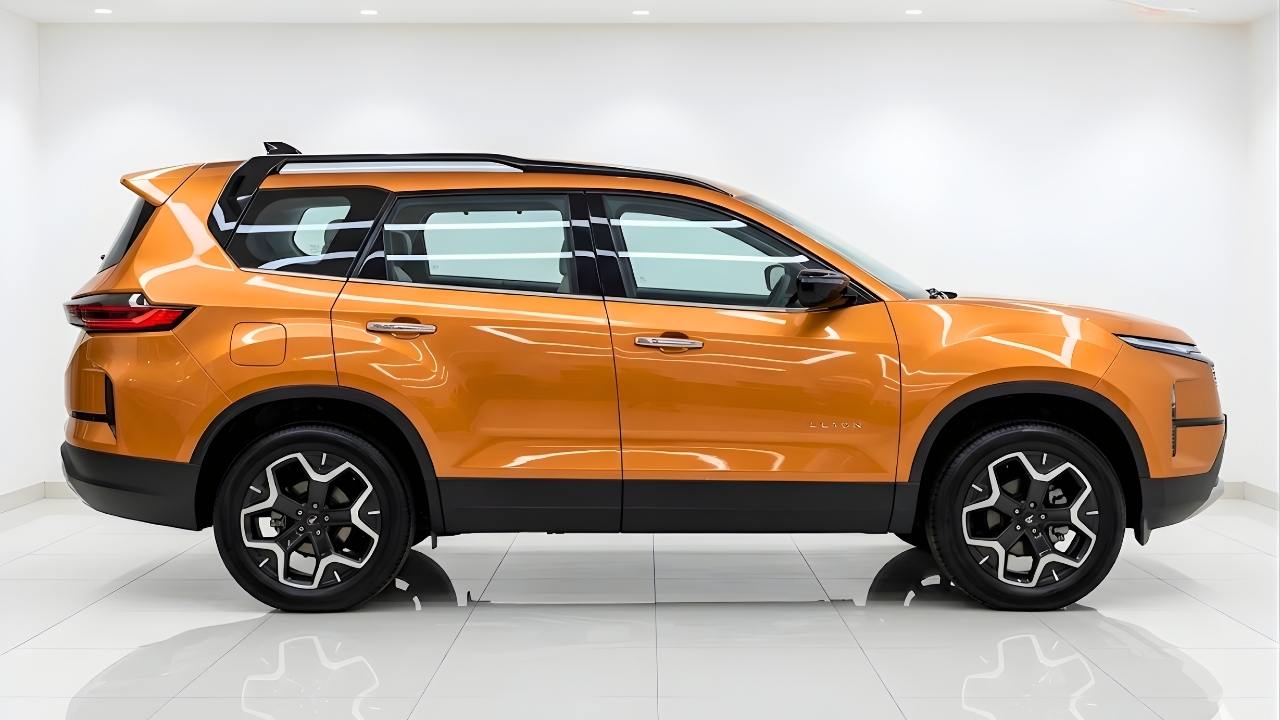
Tata Motors is all set to tata safari ev launch in the festive season of 2026; it will be the first electric car from the brand with the seating capacity of 6-people and 7-people that is likely to share the underpinnings of the Harrier EV. In the Indian market, its main rival will be the Mahindra XEV 9S.
Reports say that the production of the Safari EV will start most probably in August 2026, the launch will take place by late October 2026, and delivery is expected shortly after that. Like other electric vehicles from Tata Motors, it will also be introduced in multiple trims with different price tags.
It is confirmed to be based on the brand EV platform, acti.ve+, so the interior is likely to be similar to the one available with traditional powertrains. The ex-showroom price for Safari EV is expected to be between ₹25 lakh and ₹30 lakh based on trims.
Interior & Features
Its interior is going to be equipped with high-tech, smart and advanced features to ensure comfortability, safety and convenience. The cabin features a premium dual-tone dashboard and soft-touch materials with a large screen as a digital cluster and infotainment with wireless Android Auto & Apple CarPlay and a premium sound system.
The Safari EV is all set to get TiDAL that features OTA updates, a 540° surround view camera, auto park assist, Summon mode, UPI-based in-car payments, off-road cruise control and Level 2 ADAS. Features like ambient lighting, ventilated front and rear seats, wireless phone charging and a large panoramic sunroof will also be available.
Exterior & Design
The Safari EV will come with the same design philosophy that is used in their ICE variants, but it will feature a closed-off grill to make its EV stylish. It will get sleek connected LED DRLs, slim LED headlamps and a redesigned bumper for better airflow.
It may get a flush-type door for better aerodynamics, black cladding, roof rails and 18–19 inch alloy wheels with finishing touches for better efficiency. Its rear will feature a clean and modern tailgate, connected LED taillamps, a stylish bumper and EV badging.
Dimensions & Space
The dimensions of the Safari EV will be the same as its ICE variants. It measures 4668 mm in length, 1922 mm in width and 1795 mm in length. The wheelbase of 2741 mm will provide better legroom with a flat floor for all occupants, and a ground clearance of 205 mm will help it to navigate through the potholes.
It will feature a seating capacity of 6 people and 7 people with a layout of 2-2-2 and 2-3-2. The boot space is expected to be more than its ICE variants; it is likely to feature the cargo space of 500 litres. The foldable rear seats will increase the boot space up to 1200 litres.
Battery & Range
The Safari EV will be introduced with two battery packs that are 65 kWh and 75 kWh, the same as the Harrier EV. The range for both battery packs is likely to be a little less compared to its sibling because it will be quite heavier. The expected range for a standard battery is 500 km, and a large battery pack is 600 km.
Charging
Like the Harrier EV, the Safari EV will also be based on 400-volt electrical architecture and expected to support DC chargers up to 100 kW. It will charge the vehicle with a 65 kWh battery and a 75 kWh battery from 20% to 80% in just 25 minutes and 30 minutes, respectively.
It will support an AC charger up to 11 kW, since its sibling does so; at home you will be able to charge the Safari EV with standard range and long range from 10% to 100% by giving it time with 6-7 hours and 8-9 hours, respectively.
Powertrain & Performance
The Safari EV will be introduced with a single-motor RWD drivetrain with a 65 kWh battery pack and a double-motor AWD (QWD) configuration for a 75 kWh battery. The transmission will be single-speed automatic in all variants.
Like its sibling, also its power output for RWD trims and AWD (QWD) trims will be 235 bhp and 390 bhp, respectively, and the torque will be 500 Nm. The acceleration timing is expected to be the same as its sibling’s, 6-7 seconds for RWD trims and 8-9 seconds for AWD (QWD) variants.
