
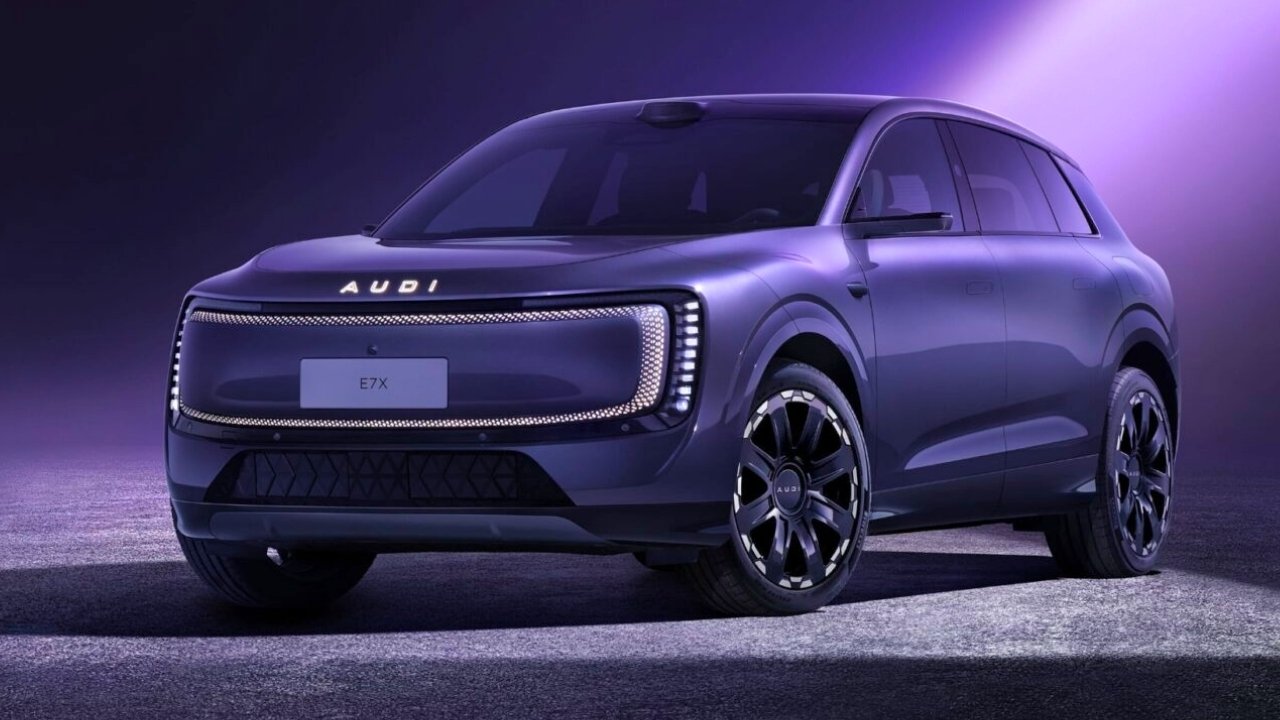
After starting the AUDI E7X presale on May 8, 2026, with the price of 289,800 yuan to 379,800 yuan (₹41.1 lakh to ₹53.9 lakh) for the Chinese market, now SAIC Audi is all set to launch it on May 29, 2026, and then the delivery will begin shortly after that. The price of this full-size SUV is yet to be confirmed; reportedly it will be between 239,800 yuan and 329,800 yuan (₹33.9 lakh to ₹46.8 lakh).
Notably, this SUV is built on the Advanced Digitised Platform, a next-generation EV platform that Volkswagen’s Audi and SAIC had co-developed. Comes with the Momenta Flywheel AI Driving System that uses AI-based driving assistance for highway autonomous assistance, lane centring, adaptive cruise control, smart overtaking, urban navigation assistance and intelligent parking.
The brand showcased the AUDI E7X at the 2026 Beijing Auto Show and unveiled many details about its exterior and design. This is going to be the second car from SAIC Audi; the first one is the AUDI E5, which was introduced back in September 2025 with the price of 235,900 yuan to 319,900 yuan (₹27.3 lakh to ₹37 lakh). Its third model is all set to make its debut in 2027; however, the name is still pending.
Following the launch in the Chinese market, it will compete with the Tesla Model Y that is available with the price of 263,500 yuan to 313,500 yuan (₹30.5 lakh to ₹36.3 lakh), the Li Auto L9 that costs 409,800 yuan to 439,800 yuan (₹47 lakh to ₹51 lakh) and the upcoming Aito M9, whose launch is slated for May 27, 2026, and it is likely to cost around 449,800 yuan to 619,800 yuan (₹64 lakh to ₹88 lakh).
It is set to launch in China with an all-electric powertrain in both single-motor rear-wheel drive and double-motor all-wheel drive drivetrains. The RWD variant generates the maximum power of 300 kW and peak torque of 500 Nm, but the AWD does 500 kW and 800 Nm. The RWD and AWD variant are available with two LFP batteries which are 100 kWh and 109 kWh, whose CLTC range is 705 km and 751 km for RWD and 635 km and 660 km for AWD, respectively.
The RWD variant with the standard battery pack has a kerb weight of 2,482 kg, a variant that comes with the air suspension, whose kerb weight is 2,497 kg, and it offers only 691 km on a full charge in the CLTC condition. The RWD variant with the standard battery pack can accelerate from 0 to 100 km/h in 5.82 seconds, but with the larger battery, the time increases to 6.25 seconds. On the other hand, the AWD variant with both battery packs takes only 3.9 seconds to sprint from 0 to 100 km/h.
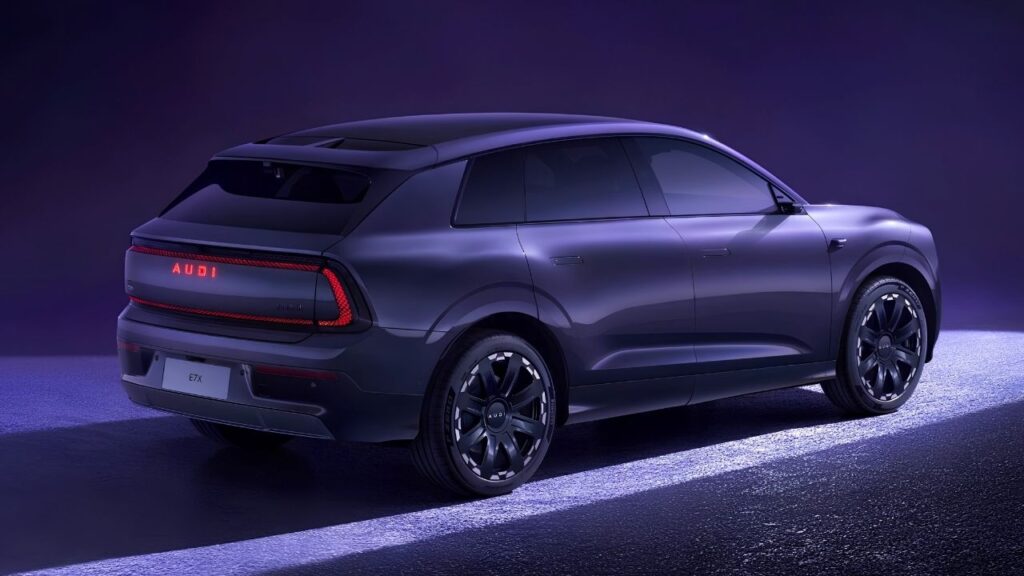
Dimensionally, it is 5,049 mm in length, 1,997 mm in width and 1,710 mm in height. Its wheelbase is 3,060 mm; compared to the Xiaomi YU7 GT, it is 60 mm longer. Up front, it features DLP digital matrix LED headlights giving a modern look and roof-mounted LiDAR, reflecting that this car is equipped with smart tech. In profile, it features flush retractable door handles giving a premium touch and large alloy wheels for bold road presence. At the rear, it comes with a full-width LED taillight, creating a wide stance, and a roof-mounted spoiler to reduce turbulence.
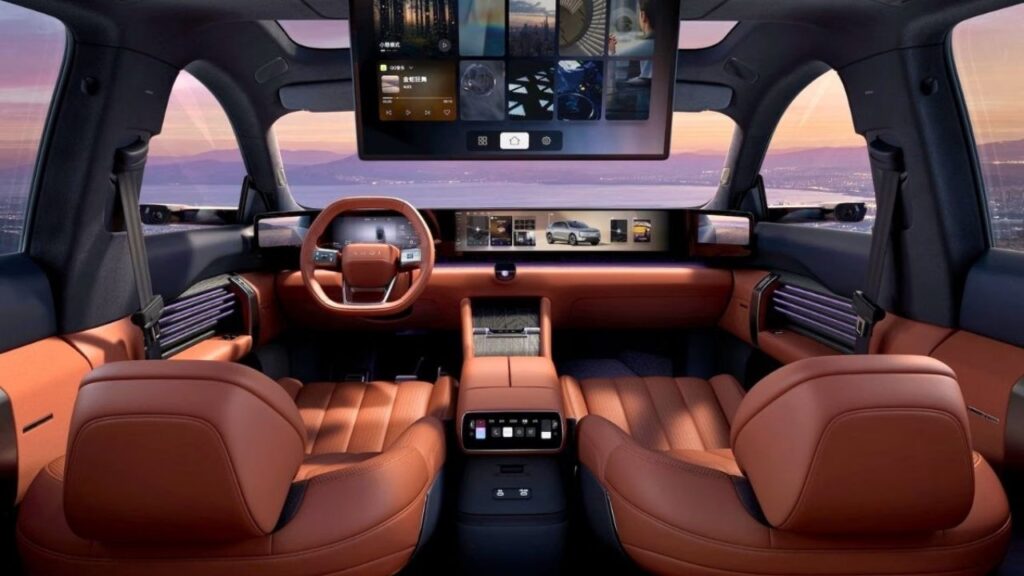
Reportedly, it will launch in two seating configurations. The four-seater and five-seater with layouts of 2-2 and 2-3, respectively. The interior gets a massive 59-inch panoramic display that runs on AUDIOS’ operating system and is powered by the Qualcomm Snapdragon 8295 chipset. Even get a ceiling-mounted 21.4-inch entertainment screen for the second-row seating passenger with a set of 26 speakers and a BOSE premium audio system.
