
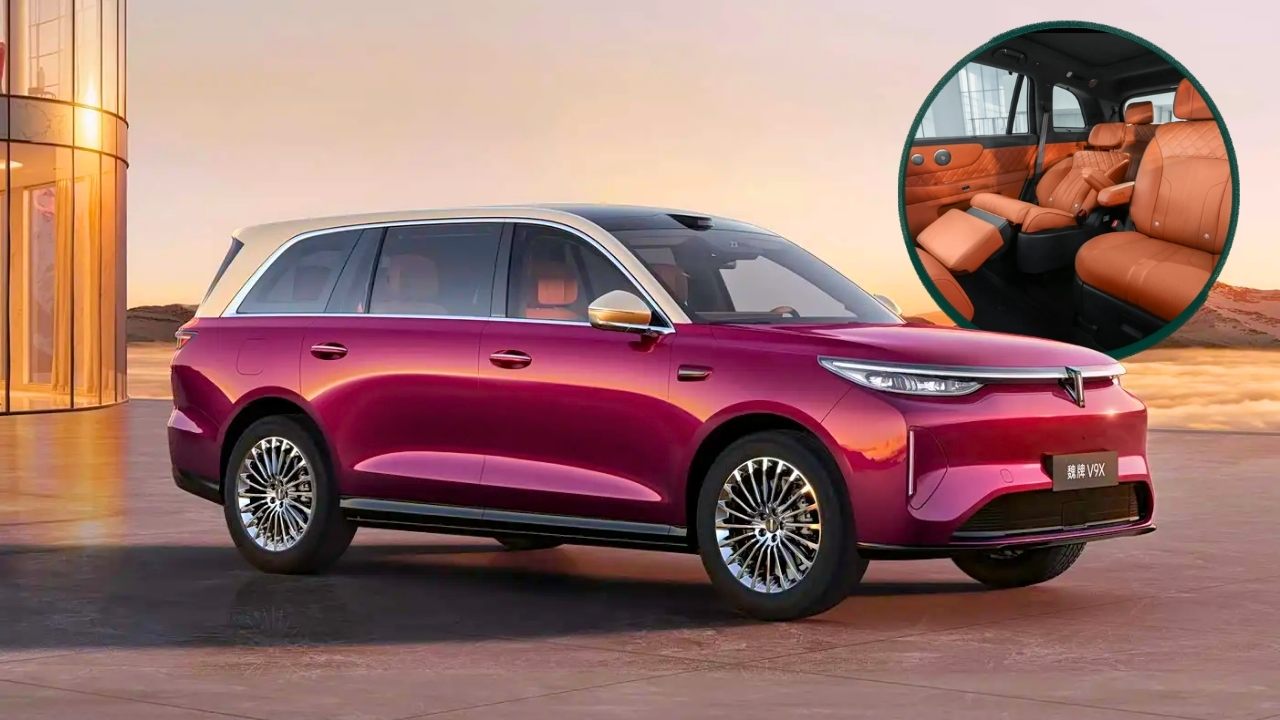
Great Wall Motor’s Wey has launched the six-seater plug-in hybrid SUV Wey V9X on May 18, 2026, with the starting price of 349,800 yuan (41.1 lakh rupees), after starting the pre-sale on April 17, 2026. It is available in two sizes, the first one with the standard wheelbase of 3,050 mm, whose length, width, and height are 5,205 mm, 2,025 mm, and 1,825 mm, respectively, and the long wheelbase of 3,150 mm, whose length is 5,299 mm, width is 2,025 mm, and height is 1,825 mm. The measurements are similar to Aito M9 and Li Auto L9.
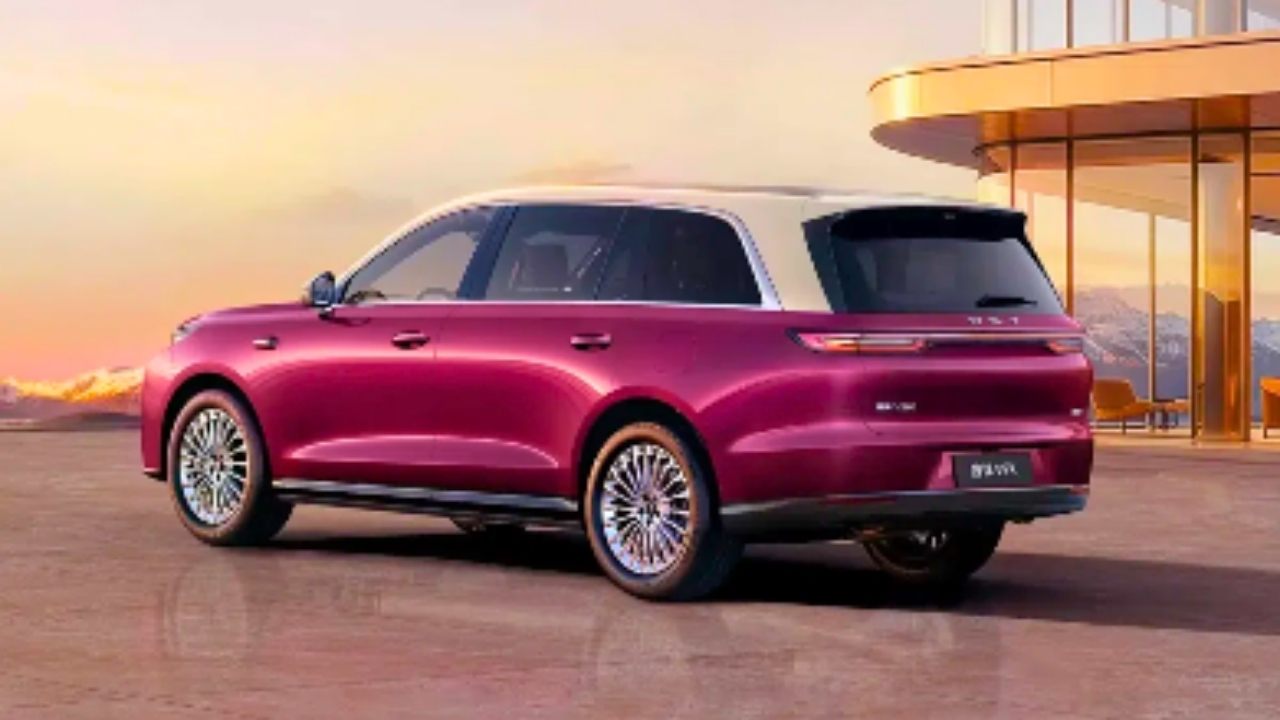
Upfront, it features full-width LED daylight running lights that look connected with the LED headlights just placed below the DRL on both sides, featuring a modern lighting signature that makes its front end look eye-catching. On the sides, it features silver-coloured ORVMs and mechanical door handles and large multi-spoke alloy wheels. At the rear, it features a roof-integrated spoiler and full-width LED taillights, creating a wide stance.
It is built on GWM’s Global One S platform; it features a dual-chamber air suspension system. The front suspension is double-wishbone independent, which ensures better wheel control during cornering and also improves steering precision, and the rear is multi-link independent, which improves rear passenger comfort and reduces cabin vibrations. The braking of all wheels is managed by a ventilated disc, and also gets braking features including ABS with EBD and regenerative braking.
It comes with three LFP battery packs that are 66.6 kWh, 55.4 kWh, and 80 kWh, whose only-electric CLTC range is 402 km, 310 km, and 470 km, respectively. Notably combined, meaning when the battery is fully charged and the fuel tank is also full, its CLTC range with the first, second and third battery pack options is 1,632 km, 1,656 km and 1,700 km, respectively. It is built on 800-volt electrical architecture and supports 6C fast charging. As a plug-in hybrid vehicle, it has a 2.0-litre turbocharged petrol engine under the hood that is bolted with the four-speed hybrid gearbox, whose maximum power output is 174 kW.
It comes with a dual-motor setup, one on the front axle and another on the rear, featuring an all-wheel drive configuration. The maximum power output for the front motor is 100 kW, but the rear one generates the peak power of 220 kW, 240 kW and 270 kW, with the 66.6 kWh, 55.4 kWh, and 80 kWh battery packs, respectively; and the combined peak power output is 500 kW with the first battery pack option, 510 kW with the second, and 550 kW with the third one. The acceleration timing for 0 to 100 km/h is only 5 seconds on all variants, and top speed goes up to 225 km/h.
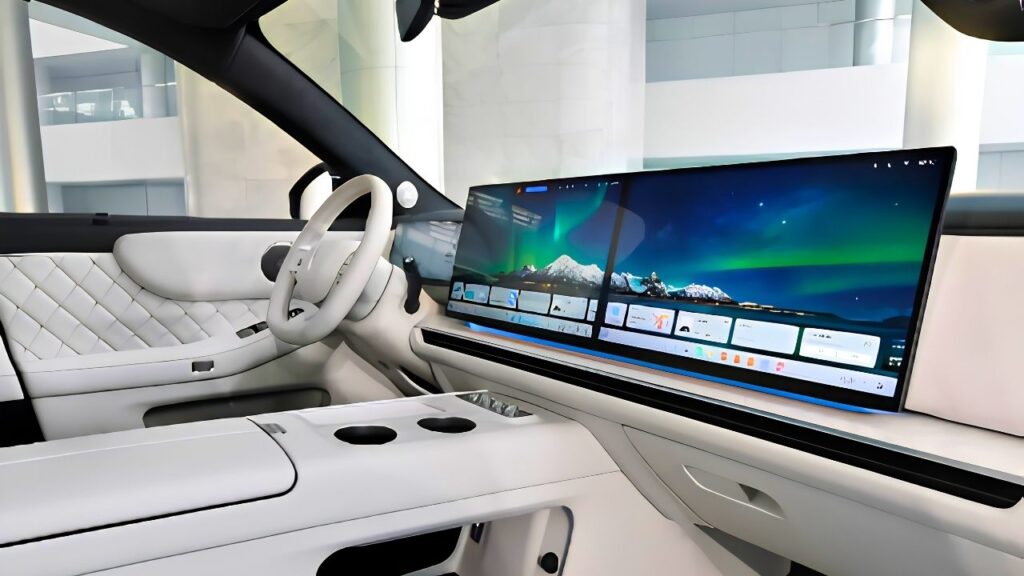
It comes with a seating capacity of 6 people in a layout of 2-2-2, meaning two seats are present in each row. The cabin is equipped with a 17.3-inch central infotainment display at the centre of the dashboard that acts as a control panel, a 17.3-inch front passenger-side entertainment screen, a 12.3-inch fully digital instrument cluster under the steering wheel, and 21.4-inch rear entertainment; they are powered by the Qualcomm 8295P chip. It features 31 rare-earth magnetic speakers, whose peak amplifier power is 3,080W.
The second-row features are zero-gravity captain seats with a 22-point massage function; they also come with ventilation and heating functions. Notably, it gets a Thor-U autonomous driving chip with 27 high-performance sensors which has a computing power of 700 TOPS (Trillions of Operations Per Second).