
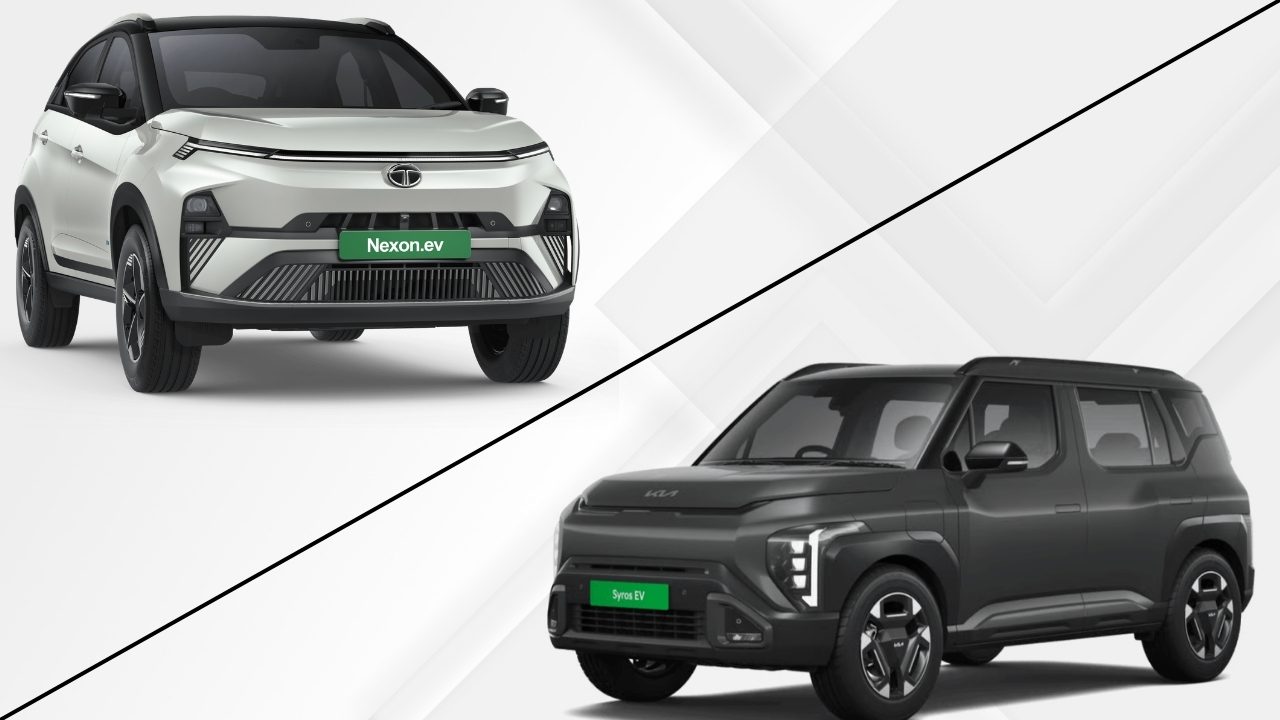
Kia India launched the Kia Syros EV on July 24, 2026, in the Indian market in multiple variants, whose ex-showroom price starts from ₹13.50 lakh and goes up to ₹20.00 lakh. There are multiple rivals in the Indian market, one among them being the Tata Nexon EV, which costs ex-showroom between ₹12.50 lakh and ₹17.70 lakh.
Here, we have come with the side-by-side comparison between the top-end variants of them, which are the Syros EV X-Line ER and the Nexon EV Empowered Plus A 45.
Ex-showroom Price
The Kai Syros EV X-Line ER and Tata Nexon EV are available for sale with the ex-showroom prices of ₹20.00 lakh and ₹17.70 lakh, respectively. It is clear that in terms of the price, the model from the Indian automobile manufacturer is affordable by ₹2.30 lakh. If looking for an affordable option, then the Kia Syros EV is an ideal option for you.
Dimensions
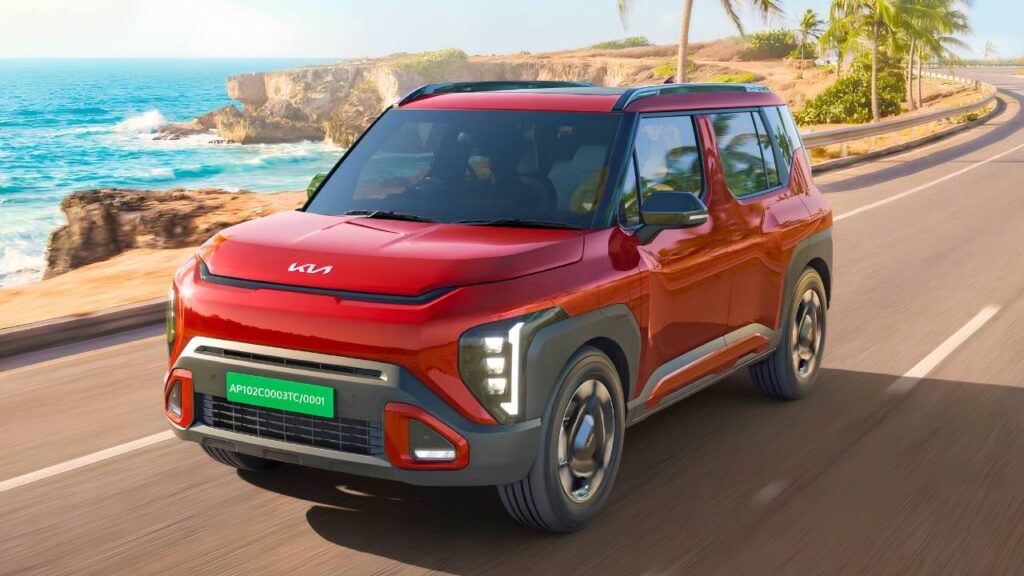
The length, width, height, wheelbase, and ground clearance of the Kai Syros EV X-Line ER are 3,995 mm, 1,805 mm, 1,670 mm, 2,550 mm, and 189 mm; on the other hand, the Tata Nexon EV Empowered Plus A 45 measures 3,995 mm, 1,802 mm, 1,625 mm, 2,498 mm, and 190 mm.
Notably, both are small in terms of length, but the Kai car is one that has 52 mm more wheelbase, the distance between the wheels. It is 3 mm and 45 mm wider and taller, respectively. The Kia vehicle has just 1 mm less ground clearance.
The most important aspect of the dimension comparison is the wheelbase, as it reflects how much space the second-row seating passengers get. The Kia car has the longer wheelbase; buyers who want to have an EV with a spacious cabin should definitely opt for the Kia Syros EV.
Battery Pack, Range & Charging
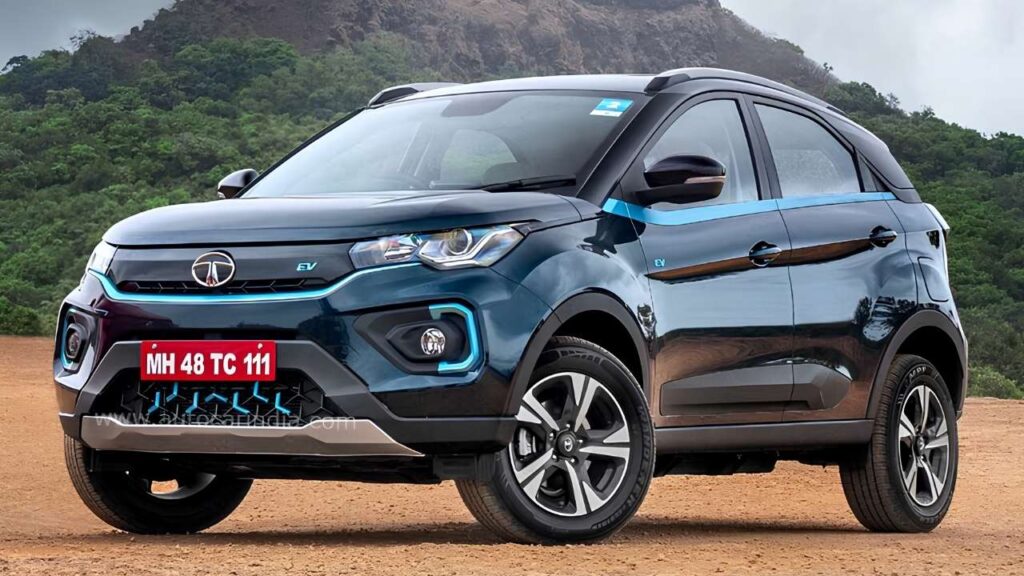
The Syros EV X-Line ER gets a 51.4 kWh lithium-ion battery pack, whose MIDC range is 526 km. It supports a DC charger up to 100 kWh that takes 39 minutes for 10 to 80 percent charging. Comes with an 11 kWh AC charger, which takes 4.5 hours for 10 to 100 percent charging.
On the other hand, the Nexon EV Empowered Plus A is equipped with a 45 kWh lithium-ion battery, giving a range of 480 km in MIDC conditions. It supports DC chargers up to 60 kW, which take 40 minutes for 10 to 80 percent charging. It comes with a standard 7.2 kW AC charger, which takes 6 hours for 10 to 100 percent charging.
The Kia car’s battery pack is 6.4 kWh larger, giving 37 km more range in MIDC conditions. Its DC charging time for 10 to 80 percent is just 1 minute less, but AC charging time for 10 to 100 percent is 1.5 hours less. In all terms such as battery pack, range, and charging, the Kia vehicle wins. Definitely choose the Kia if you need better range and fast charging with both AC and DC chargers.
Features & Technology
Both have a 12.3-inch touchscreen infotainment system, but the Kia also has a 12.3-inch digital instrument cluster, 2.05 inches larger. Inside the cabin, there are many features that are available for both, including Blind View Monitor, 360-degree Camera, Ventilated Front Seats, Panoramic Sunroof, and Wireless Android Auto & Apple CarPlay.
The Kia car’s infotainment system is integrated with 8 speakers of Harman Kardon Premium Audio, but the Nexon has a JBL 9-speaker system. Both have electronic adjustable driver seats; for Kia, it is adjustable in 4 ways, and for Tata, it is in 9 ways. They also support V2L, V2V, over-the-air software updates, Level 2 ADAS, and six airbags.
In terms of features and technology, they are both quite similar. If you are looking for a vehicle with a larger digital instrument cluster, then opt for a Kia car, and if it’s better seating comfort as a driver, then a Tata vehicle, because its driver seat is adjustable in two more ways.
