
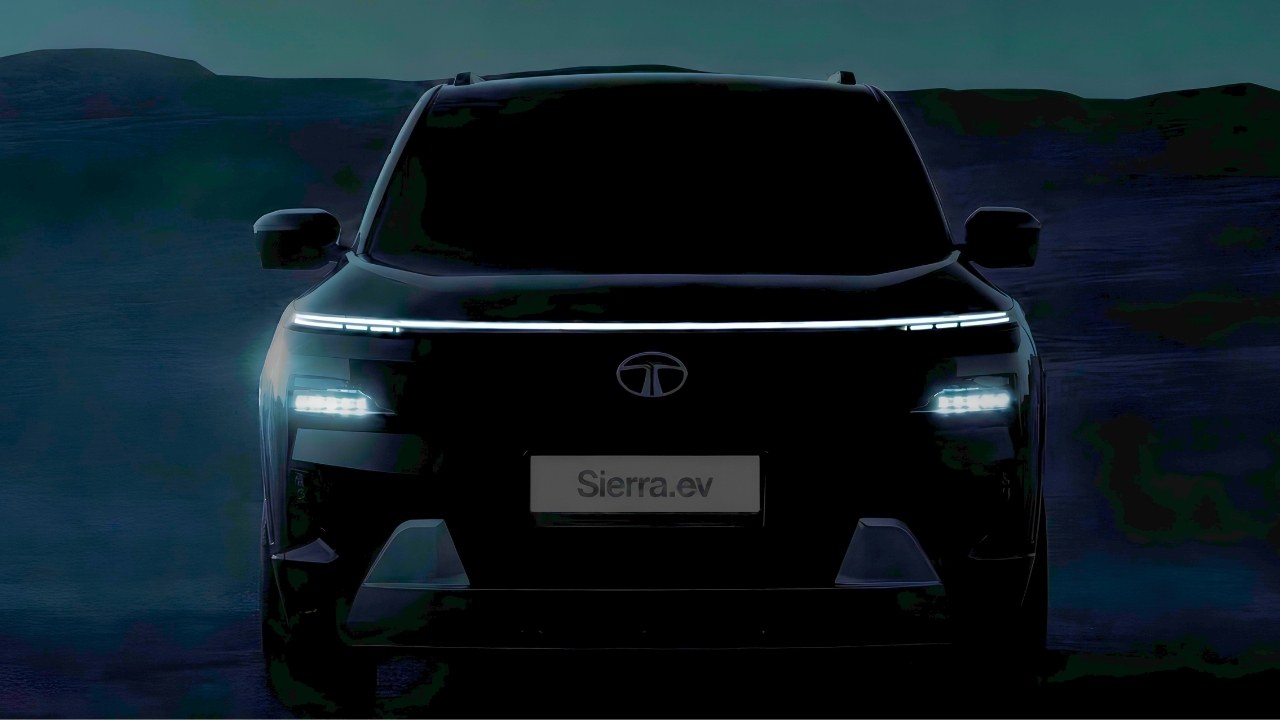
Tata Motors has teased the upcoming Sierra EV, a mid-size electric vehicle, before June 30, 2026. The seven pure-electric models from the carmaker will make their debut in the domestic market with the expected ex-showroom price between ₹18 lakh and ₹25 lakh. The teaser they have released shows the front-end lighting signature.
The image they have shared online confirms they are upfront; it is set to feature a split LED headlight setup. The full-width daylight running lights are placed just below the hood to make the front fascia modern, and the high-beam and low-beam in the horizontal-shape housing are mounted slightly below the DRLs for better nighttime visibility.
Other notable elements in the teaser image are the Tata’s logo in the center below the DRLs for branding and the closed-off grill for a cleaner front-end view and better aerodynamics. The side and rear are still unveiled. We are expecting that they will be quite similar to the Sierra ICE; however, that is yet to be seen.
Its interior is also pending. The cabin will feature a seating capacity of 5 people in a layout of 2-3 with a decent boot space. In terms of dimensions, it is set to be identical to the nameplate that is already being sold with the traditional powertrain. Meaning, its dimensions are as follows:
- Length: 4340 mm
- Width: 1841 mm
- Height: 1715 mm
- Wheelbase: 2730 mm
- Ground Clearance: 205 mm
Moving inside, the cabin may have three screens, including a 10.25-inch digital instrument cluster before the driver’s seat and two 12.3-inch touchscreens, one at the dashboard’s center and another before the co-passenger’s seat for entertainment purposes.
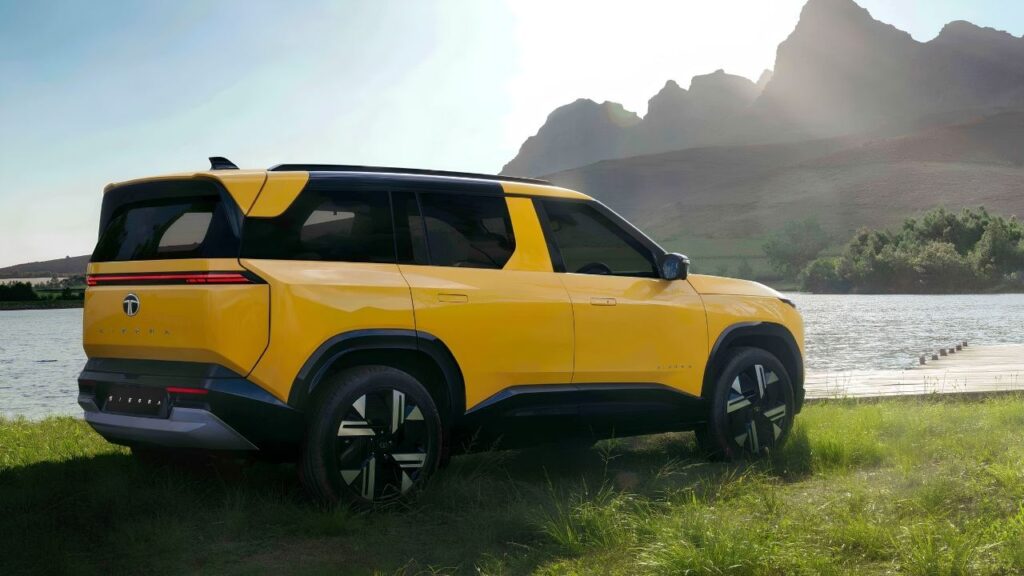
The Sierra with a petrol-powered internal combustion engine has a boot space of 622 liters; we are expecting that the upcoming pure-electric counterpart will have better cargo capacity because of the flat floor.
The infotainment and entertainment screen is set to be integrated with a multiple-speaker premium sound system, and it will support multi-device wireless connectivity. With Android-based operating systems, both touchscreens will support over-the-air software updates, connected car technology, and AI-based voice assistants.
Compared to the ICE version, the EV is anticipated to feature more soft-touch, premium-like material for seating and dashboard trims. Other features that these Tatas may get are as follows:
- Wireless phone charging pad on the center console,
- Storage compartment in both the front and second rows,
- Electrically adjustable panoramic sunroof,
- Automatic climate control,
- Six airbags, and
- Level 2 advanced driving assistant system.
Shifting focus to powertrain. Reportedly, the Sierra EV will borrow the battery pack from its sibling Harrier EV. Meaning, Tata Motors may introduce it with two LFP battery pack configurations that are 65 kWh and 75 kWh. With the standard battery pack, the EV may run around 500 km and near 600 km with the large option in the real world.
Details regarding the motor setup are still pending. Speculation is that the carmaker will introduce it as both RWD and AWD. If this happens, then the rear-wheel-drive variant will get a permanent magnet synchronous motor on the rear axle with a single-speed automatic transmission, and the all-wheel drive will also feature a synchronous motor on the front axle.
The Sierra EV is built on Acti.ev+ architecture, whose front suspension is an independent MacPherson strut with coil springs, and the rear is a multi-link independent one. The braking work for the front and rear wheels is done by ventilated discs and discs featuring ABS with EBD, ESC, brake assist, and regenerative braking.
The upcoming all-electric Sierra is set to be positioned between the electrified Currv and Harrier. Once launched, it will take on mid-size electric SUVs such as the Mahindra BE 6, the Hyundai Creta Electric, the MG ZS EV, and the Maruti Suzuki eVitara.
